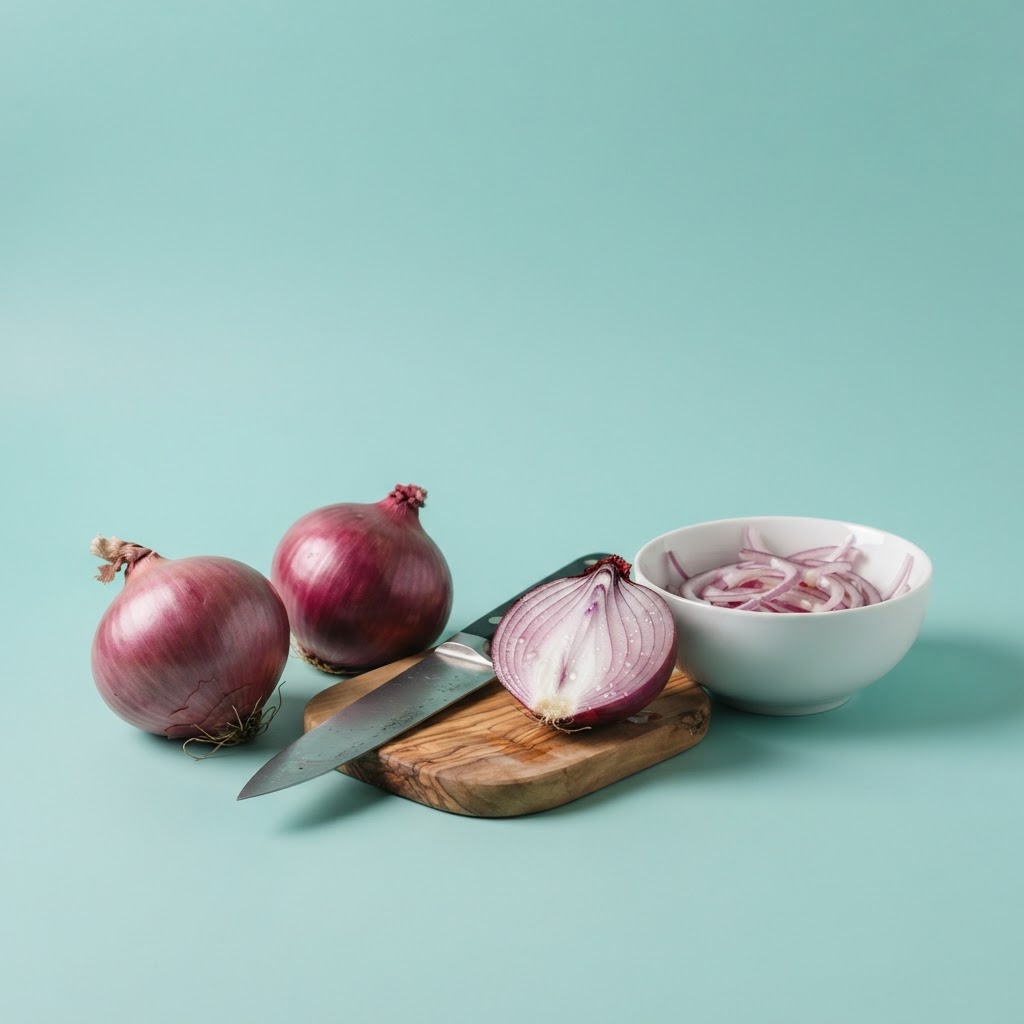

The Chemistry: What Actually Happens When You Cut an Onion
An onion is a bundle of cells sitting quietly, doing nothing offensive. The moment you cut into it, though, you set off a chain reaction that would impress a chemist. Here's what's happening at the molecular level:
Onions absorb sulfur from the soil as they grow and store it as amino acid sulfoxides — particularly a compound called S-1-propenyl-L-cysteine sulfoxide. These sit in one part of the cell. In a different part of the cell sits an enzyme called alliinase. As long as the cell is intact, these two never meet.
When your knife breaks the cell walls, the amino acid sulfoxides and the alliinase mix. The enzyme goes to work, converting the sulfoxides into 1-propenesulfenic acid. So far, so harmless. But the onion has one more trick: a second enzyme called lachrymatory-factor synthase takes that sulfenic acid and converts it into syn-propanethial-S-oxide — the actual tear gas.
This compound is volatile, meaning it turns into a gas at room temperature and floats up toward your face. When it reaches your eyes, it dissolves in the film of tears covering your cornea, forming a very dilute sulfuric acid. Your eyes' nerve endings detect the acid and signal the brain to produce more tears to wash it away. That's the crying.
Why Did Onions Evolve to Make You Cry?
The tear gas isn't an accident — it's a defence mechanism. Wild onions evolved these sulphur compounds to deter animals from digging them up and eating them. The same chemicals that make you cry also give onions their pungent flavour and antimicrobial properties. In a sense, the onion is fighting back.
Interestingly, garlic, leeks, and shallots — all members of the Allium genus — have similar sulphur chemistry, but they don't produce the lachrymatory factor. That's because they lack the specific enzyme (lachrymatory-factor synthase) that converts the intermediate compound into the tear gas. Garlic makes you smell, not cry. See our garlic guide for more on allium chemistry.
Do All Onions Make You Cry Equally?
No — some onions are far worse than others. The amount of syn-propanethial-S-oxide an onion releases depends on variety, growing conditions, and freshness:
- Red onions tend to be moderately pungent.
- Brown/yellow storage onions (the common cooking onion in Australia) are usually the most pungent because they're bred for long storage and develop higher sulphur content.
- White onions are moderately pungent, often slightly milder than brown.
- Spring onions (scallions) are much milder — the green tops barely affect your eyes at all.
- Sweet onions (like Vidalia or Walla Walla) are the mildest. They're grown in low-sulphur soils, which means less of the precursor compounds. They'll still make some people tear up, but much less than a storage onion.
If you want to know more about onion varieties and storage, see our onion storage guide and our onion harvesting guide.
7 Proven Ways to Stop Onions Making You Cry
Some of these are backed by science, some by kitchen tradition. All of them reduce the amount of syn-propanethial-S-oxide that reaches your eyes:
- Chill the onion first. Put the onion in the fridge for 30 minutes or the freezer for 10-15 minutes before cutting. Cold temperature slows down the enzyme reactions, producing less tear gas. This is the most effective method supported by science.
- Use a very sharp knife. A sharp blade damages fewer cells than a dull one, so less enzyme is released. It's a small effect, but it helps — and a sharp knife is safer anyway.
- Cut under running water or in a bowl of water. The gas dissolves in the water before it reaches your eyes. This works well but is fiddly — the onion can slip, and you lose some flavour into the water.
- Leave the root end intact until last. The root end has the highest concentration of sulphur compounds. By cutting it last and minimising how much you slice through it, you release less gas.
- Use a fan. A small fan or your rangehood on high, blowing the gas away from your face, stops it reaching your eyes. Simple but effective.
- Wear goggles. Swimming or onion goggles seal around your eyes, so the gas can't get in. It looks silly, but it's the most effective method if you're very sensitive.
- Cut near an open flame. Some people swear by lighting a candle nearby — the theory is that the flame draws the gas upward. The evidence is mixed, but it doesn't hurt to try.
Why Do Some People Cry More Than Others?
If you're the one in the kitchen who always ends up streaming tears while everyone else seems fine, it's not your imagination. Several factors affect how much onions affect you:
- Eye sensitivity. Some people simply have more sensitive corneas and tear ducts. If you're prone to dry eyes or wear contact lenses, you may react more.
- Tear production rate. People who produce tears quickly wash the irritant away faster and cry more. It sounds backwards, but the more your eyes water, the more the gas gets flushed — but also the more you notice it.
- Contact lenses. Contacts can actually protect your eyes by creating a physical barrier. Some people find they cry less when wearing lenses.
- Height. Taller people have more distance between the cutting board and their eyes, giving the gas more time to disperse. Shorter people get a more concentrated dose.
Is the Gas from Onions Dangerous?
No. Syn-propanethial-S-oxide is irritating but harmless. The sulfuric acid it forms in your tears is extremely dilute — nothing like actual battery acid. Your eyes recover within minutes of finishing the onion. There's no long-term damage from normal cooking.
However, if you get onion juice directly in your eye, that's a different story. The juice contains higher concentrations of the irritant and can cause more significant stinging and redness. Rinse with plenty of cool water if this happens. See our storage guide for safe onion handling.
Can You Buy Tear-Free Onions?
Yes, actually. Scientists have bred onions that produce little or no lachrymatory factor. The most famous is the "Sunions" brand, developed through conventional breeding (not genetic modification) in the United States. They're designed to be sweeter and less pungent, and they do produce significantly less tear gas as they cure.
In Australia, sweeter onion varieties like Gladalan and some locally grown sweet onions are milder, though not as dramatically as Sunions. If you cook with onions a lot and find the tears genuinely bothersome, seek out sweet varieties. See our produce deals guide for finding the best onions at Australian supermarkets.
Cook Smarter with Your Onions
Once you've conquered the crying, you still need to use those onions before they sprout or go soft. Scan your onions with PickFresh to check freshness, or try our Fridge Scan tool — snap a photo of your fridge and get instant recipes using whatever onions and other ingredients you have on hand. No more waste, no more wondering what to cook.
Frequently Asked Questions
Cutting an onion breaks its cells, releasing an enzyme called alliinase that converts sulfur compounds into syn-propanethial-S-oxide. This volatile gas floats up to your eyes, dissolves in your tears, and forms a mild sulfuric acid that stings — triggering your eyes to produce more tears to wash it away.
Freshness Checker
Type any produce to get freshness tips instantly
Powered by PickFresh AI · Scan real produce with your camera →