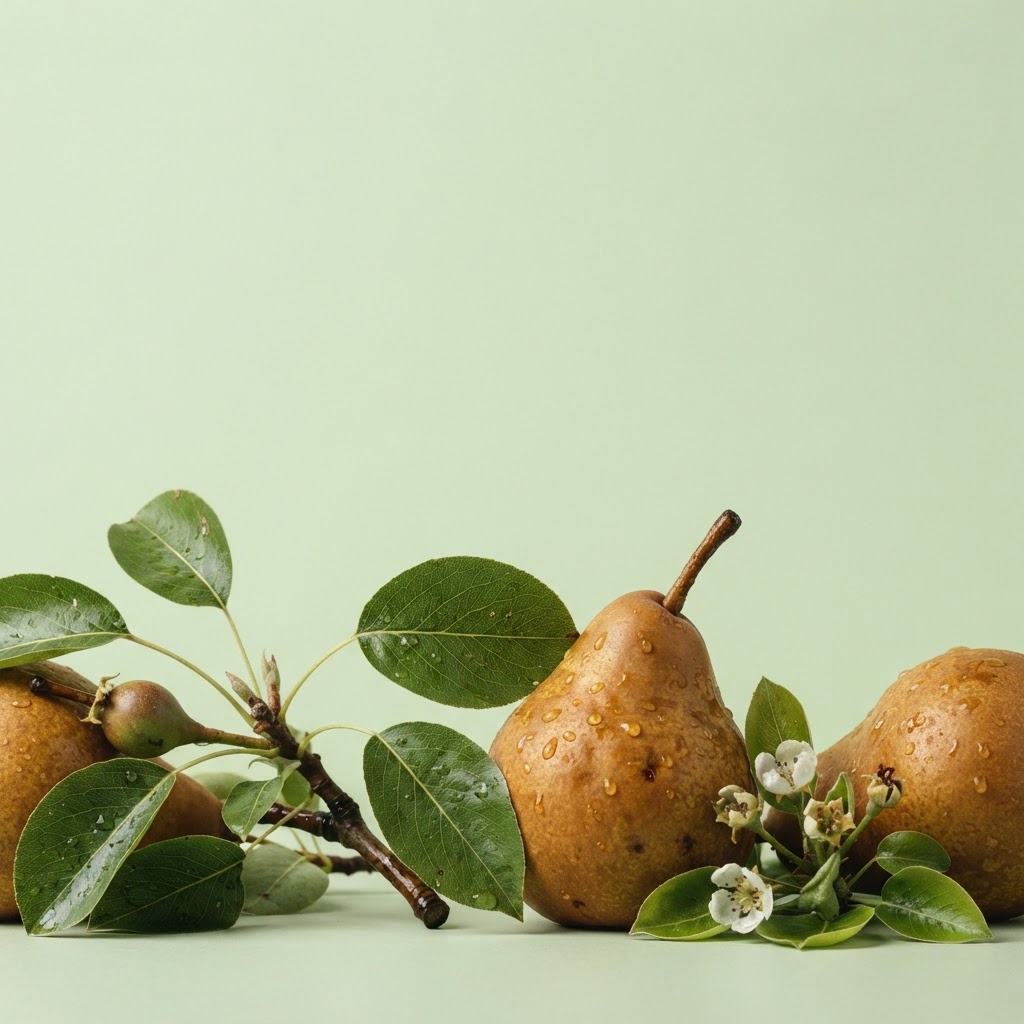
A pear tree looks like several different trees depending on the month. In January it is a bare skeleton. In September it is a dark green mass. The trick is to know which features survive which season, so you always have something to check.
Spring: Blossom
Pear blossom is one of the first things to happen in a fruit garden. The flowers open before or with the leaves, and they are pure white — five rounded petals around a cluster of stamens tipped with dark red or purple anthers.
That dark anther colour is a useful detail. Apple blossom is white flushed with pink and the anthers are yellow. Pear anthers are noticeably dark, which gives a pear tree in full flower a faintly speckled look up close.
Pear blossom also appears earlier. If you have two unidentified fruit trees and one is flowering a fortnight ahead of the other, the early one is more likely to be the pear — and it is also the one more exposed to late frost, which is why pear crops fail more often than apple crops in cold districts.
Summer: Leaves
Leaves are covered in detail in our pear tree leaves identifier, but the short version: glossy, oval to egg-shaped, finely toothed, on a long stalk, held alternately and often hanging. Quince is fuzzy and grey; apple is duller with a shorter stalk.
Autumn: Fruit
Pear fruit shape is the giveaway. Most pears are pyriform — narrow at the stem, swelling toward the base — which is why a pear silhouette is instantly recognisable in a way an apple is not.
- European pears. Bell, teardrop or bottle shaped, soft and buttery when ripe. Packham, Williams, Beurré Bosc, Conference, Comice.
- Asian pears. Round like an apple, crisp and juicy, never softening. Corella (Nashi), Hosui, Nijisseiki.
- Wildings and seedlings. Often small, hard and gritty, with a heavy astringent taste. Edible in principle, unpleasant in practice.
A pear also ripens differently from almost any other fruit. It ripens from the inside out, so the centre can be soft and mealy while the outside still feels firm. The reliable test is the stem end: press gently beside the stalk, and when it gives slightly, the pear is ready. That behaviour is covered further in our guide to when pears are in season.
Winter: Bark and Buds
This is where most people give up, and it is also where pears become surprisingly identifiable.
Bark. Mature pear bark is grey-brown and cracks into small, flat, plate-like scales. It is less deeply fissured than apple, which tends to develop rougher vertical cracks, and it does not peel in the papery strips you see on cherry.
Buds. Pear buds are pointed and cone-shaped, held slightly away from the shoot on a short stalk, and covered in overlapping scales. Apple buds are rounder, flatter and pressed closer to the stem. Once you have seen the two side by side you will not mix them up again.
Spurs. Mature pears fruit on short, knobbly spurs built up over years on older wood. A spurry, gnarled inner framework on a tree with plate-like bark is strong evidence.
Habit. Most pears grow more upright than apples, with a narrower crown and branches that angle upward rather than spreading wide. Some varieties are distinctly weeping.
The Trees Pears Get Confused With
| Tree | How to tell it apart |
|---|---|
| Apple | Pink-flushed blossom with yellow anthers, rounder buds held close to the shoot, duller leaves, rounder fruit with a deep stem basin. |
| Quince | Fuzzy grey leaves, large solitary pale pink flowers, and lumpy yellow fruit with a fuzzy skin. Bark is smoother and often flaky. |
| Medlar | Narrower leaves with a hairy underside, large white flowers, and a distinctive brown fruit with an open, flattened base. |
| Nashi / Asian pear | These are pears — the difference is fruit shape, not tree species. Round fruit, crisp flesh, often russeted skin. |
The quince confusion is the one that costs people the most time, because quince is a close relative and looks similar from a distance. The fuzzy grey leaf is the giveaway.
Spur-Bearing or Tip-Bearing?
If the tree is yours and you are deciding how to prune it, this question matters more than the species. Most pears bear fruit on short spurs on two-year-old and older wood, which means heavy pruning removes next year's crop. A minority bear at the tips of last year's shoots.
Watch where the fruit hangs. Clusters of fruit tight against thick old wood means spur-bearing. Single fruit at the ends of long new shoots means tip-bearing. If you are unsure, prune lightly and see what happens.
Rootstock also changes what the tree looks like far more than most people expect. The same variety on a dwarfing rootstock is a small tree in a pot; on a vigorous rootstock it is a full-sized standard. Tree size is therefore a poor identification clue on its own.
Getting From Tree to Variety
Species identification is the easy part. Variety is genuinely difficult — there are hundreds of named pears and many are regional synonyms. The features that matter are fruit shape, skin colour and russeting, the depth of the neck, the amount of grit in the flesh, and the ripening window. Our pear identifier works through all of those.
If you have a mystery tree and want to know when the fruit will be ready rather than what it is, the tree fruit finder covers picking times across the main tree fruits. And if the tree is bare and you are comparing it with others in the same garden, the apple tree identification guide uses the same seasonal structure.
The Short Version
Spring: pure white blossom with dark anthers, opening early. Summer: glossy oval leaves on long stalks. Autumn: pyriform fruit. Winter: grey-brown plate-like bark and pointed buds held away from the shoot. Any one of those will get you close; two together will settle it.
Frequently Asked Questions
Check it in any season. In spring, pure white five-petalled blossom with dark red or purple anthers opening slightly ahead of apples. In summer, glossy oval leaves on long stalks. In autumn, fruit with a tapering neck. In winter, grey-brown bark cracking into small plates and pointed buds held away from the shoot.