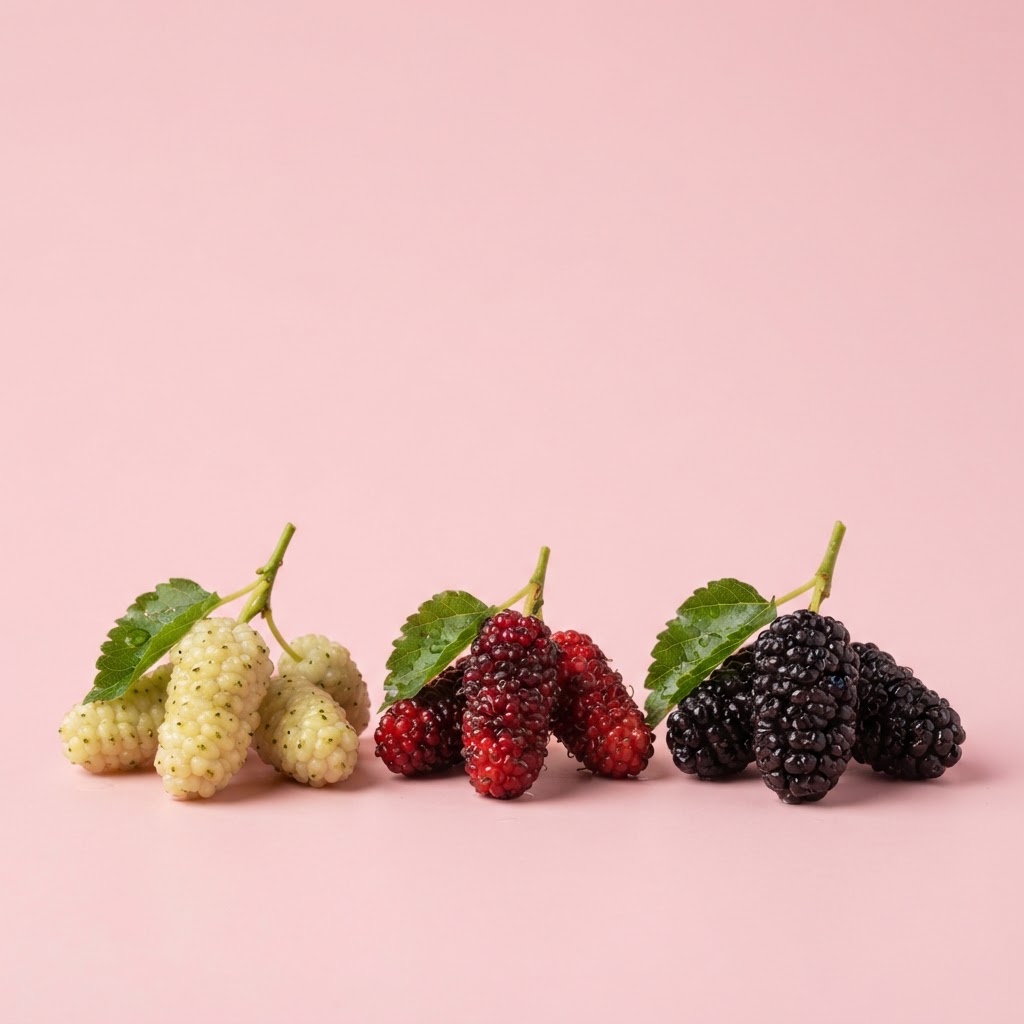
Mulberries break the rule that fruit colour tells you what you are eating. A white mulberry can produce fruit that is white, pink, red, purple or almost black, often on the same tree. If you have been identifying mulberries by the colour of the fruit, you have been identifying nothing at all.
The reliable features are on the leaves and the buds.
Why Fruit Colour Fails
The three main species are named for the colour their fruit most often takes, but the naming is loose. White mulberry, Morus alba, is named for its pale buds and pale fruit — yet many cultivated forms carry dark fruit, and the dark-fruited white mulberries are among the best eating.
So the name tells you the species, not the fruit in front of you. Treat fruit colour as a hint only.
The Leaf Test
This is the feature that works.
| Species | Leaf surface | Leaf edge | Leaf shape |
|---|---|---|---|
| White mulberry (M. alba) | Smooth, glossy, hairless | Finely toothed | Often lobed, very variable |
| Black mulberry (M. nigra) | Rough, hairy, dull | Finely toothed | Broad heart-shaped, rarely lobed |
| Red mulberry (M. rubra) | Rough on top, hairy beneath | Finely toothed | Broad, sometimes lobed |
Run your fingers over the leaf. A white mulberry leaf is smooth and almost polished, and it often shines in the sun. A black mulberry leaf is noticeably rough, like fine sandpaper, and matte.
Leaf shape is a poor clue on its own. Mulberry leaves are famously variable — often deeply lobed on vigorous young shoots and simple and heart-shaped on mature wood, sometimes both on the same branch. Do not use shape as your primary test.
Buds, Bark and Habit
Buds. White mulberry buds are pale, often reddish-brown with a lighter edge, and sit close against the shoot. Black mulberry buds are darker and more prominent. This is a winter identification feature, and it is useful when there is no leaf to feel.
Bark. Older mulberries develop a distinctive orange-brown tinge in the cracks of their bark. It is subtle but reliable once you have seen it, and it appears on all three species to some degree.
Habit. Black mulberry tends to be a smaller, broader, more spreading tree with a short trunk. White mulberry grows taller and more upright. Neither is decisive on its own.
The Fruit Itself
All mulberries are multiple fruits — each berry is formed from many tiny flowers fused together, which is why the surface is made of small bumpy segments. That structure is shared with blackberries and raspberries, though mulberries grow on trees rather than canes.
Mulberry fruit hangs from a short stalk and is elongated rather than round, usually two to four centimetres long. It stains ferociously when ripe, and the juice is used as a dye in several traditions.
Flavour is where the species differ most. Black mulberry is widely considered the best eating, with a rich, sharp, wine-like flavour. White mulberry fruit is sweeter but flatter, sometimes bland. Red mulberry sits between the two. All are edible when fully ripe.
Paper Mulberry Is Not a Mulberry
One plant causes more confusion than the rest put together. Paper mulberry, Broussonetia papyrifera, looks like a mulberry, grows like a mulberry and is often called one — but it is a different genus, and its fruit is not worth eating.
The tell is the leaf. Paper mulberry leaves are rough and hairy on the upper surface, often deeply lobed, and they are arranged in a way that is subtly different — the shoots frequently carry leaves in two rows rather than spiralling evenly. The fruit is a small, round, orange-red ball rather than an elongated berry, and it is dry and unpalatable.
Paper mulberry is grown for its bark, which is beaten into tapa cloth in the Pacific, and for paper fibre in Asia. It is also an aggressive weed in parts of eastern Australia, spreading by root suckers and by birds moving the fruit.
Other Trees Confused With Mulberry
Figs. Fig leaves are also lobed and can look mulberry-ish at a glance, but fig leaves are thick, leathery and sandpapery, and the fruit is completely different. If the tree bleeds white milky sap when you break a leaf stalk, it is a fig. Our fig leaf identification guide covers the details.
Broussonetia. Covered above — rough leaves, round fruit, not worth eating.
Some Viburnum species. Certain viburnums have rough leaves and clusters of red-to-black berries, but the berries are small and round rather than elongated, and the leaves are opposite rather than alternate. Leaf arrangement settles it: mulberry leaves alternate.
When to Pick and How to Use Them
Mulberries ripen over a long period rather than all at once, so you pick repeatedly through the season rather than harvesting a crop. A ripe mulberry falls into your hand with almost no pull. If you have to tug, it is not ready.
The fruit is very soft and does not keep. Eat it the day you pick it, or cook it the same day. Mulberries make excellent jam, cordial, ice cream and pie filling, and the unripe red fruit makes a decent tart substitute.
If you are working through a garden with several unidentified fruiting trees, the berry tree identifier covers the wider group including the toxic species, and the fruit tree leaf guide is a good next step when there is no fruit at all. Our berry identification guide covers the structural features that separate edible from unsafe fruit.
The Short Version
Feel the leaf. Smooth and glossy means white mulberry, whatever colour the fruit is. Rough like fine sandpaper means black or red mulberry, and you separate those by fruit colour and bud colour. A rough-leaved tree with small round orange fruit is paper mulberry, which is a different plant entirely.
Frequently Asked Questions
Feel the leaf. White mulberry (Morus alba) has smooth, glossy, hairless leaves. Black mulberry (M. nigra) and red mulberry (M. rubra) have rough, sandpapery leaves. Separate black from red by fruit colour and bud colour. Fruit colour alone is unreliable because white mulberry can produce white, pink or dark fruit.