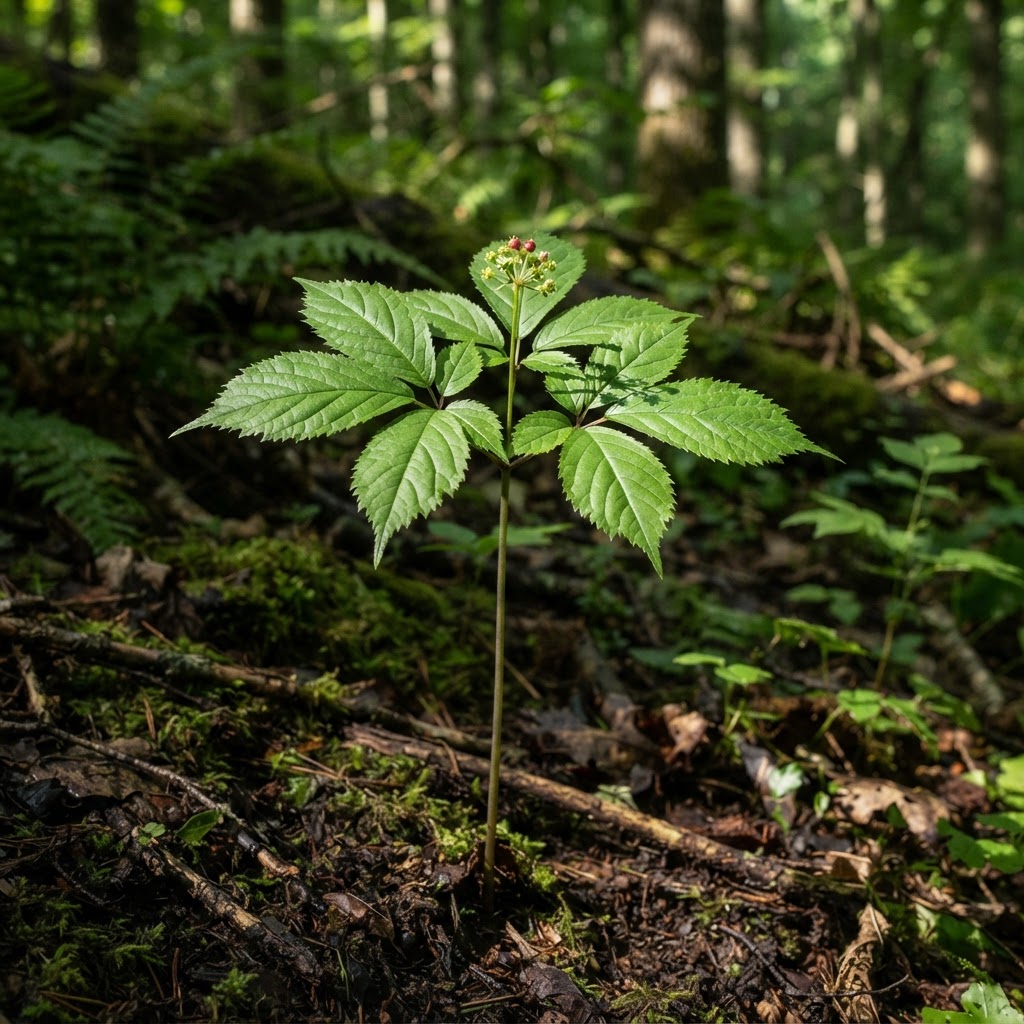
Ginseng is one of the most sought-after wild plants in the world and one of the most frequently misidentified. The root is valuable, the plant is slow-growing, and it has several common lookalikes that are either worthless or toxic.
This guide covers what true ginseng looks like, what it is confused with, and the legal and conservation situation that anyone identifying it in the wild needs to understand.
What Ginseng Looks Like
The two species most people mean are American ginseng (Panax quinquefolius) and Asian or Korean ginseng (Panax ginseng). They are close relatives with very similar above-ground appearance.
- Stem. A single erect stem, usually 20–50cm tall, smooth and pale green. One stem per plant — this matters, because lookalikes often have several.
- Leaves. Compound leaves arranged in a whorl at the top of the stem. A mature plant carries three or four, a young one just one.
- Leaflets. Each compound leaf typically has five leaflets (occasionally three), palmately arranged — all radiating from the same point, like fingers on a hand.
- Leaflet edges. Finely toothed (serrated) around the margin.
- Leaflet shape. Oval to lance-shaped with a pointed tip, 5–15cm long, with a slightly matte, slightly pleated texture.
- Flowers. Small, greenish-white and inconspicuous, in a small cluster on a stalk rising from the centre of the leaf whorl, in early summer.
- Berries. Bright red, in a tight cluster in late summer and autumn. The berries are the most conspicuous feature of a mature plant and are often the only thing visible from a distance.
- Root. Fleshy, pale, forked and often described as man-shaped. Aromatic when broken. Slow-growing — a plant takes years to reach a harvestable size.
The combination of one stem, a whorl of compound leaves at the top, and five toothed leaflets per leaf is the core identification. If any one of those is missing, you are probably looking at something else.
Where It Grows
Ginseng is a plant of mature, undisturbed hardwood forest. It wants deep shade, rich, moist, well drained soil with high organic content, and a slope rather than flat ground so water does not pool. In North America it is associated with sugar maple, beech, oak and hickory, often on north or east facing slopes.
If you find something ginseng-like in full sun, in a lawn, in a garden bed or in a wetland, it is not ginseng.
The Lookalikes
Several plants share the compound-leaf, five-leaflet look. Some are harmless, some are not.
Virginia creeper (Parthenocissus quinquefolia). The most common confusion. It has five leaflets with toothed edges and it grows in the same woods. The difference is that it is a climbing vine with tendrils, not a single-stemmed upright plant, and its berries are small and blue-black rather than a tight cluster of bright red.
Dwarf ginseng (Panax trifolius). A genuine relative but a much smaller plant, usually under 15cm, with three leaflets rather than five. It is not the commercial species.
Wild sarsaparilla (Aralia nudicaulis). Similar compound leaves in the same family, but the leaves are on separate stalks from the flower stem, and the berries are dark purple to black in round clusters.
Buckeye (Aesculus species). Also carries five to seven leaflets in a palmate arrangement, and also has a large seed. It is toxic, and it is a tree, not a low herb.
Jack-in-the-pulpit and other aroids. Different leaf structure but similar forest habitat, and often found growing nearby. Their berries form a cluster of red berries in autumn too, which is why they are sometimes mistaken from a distance. Their leaves are broad and simple, not compound.
The Legal and Conservation Picture
This is the part most identification guides leave out, and it matters more than the botany.
American ginseng is listed on CITES Appendix II, which means international trade is regulated and requires permits. In the United States, harvesting wild ginseng is regulated state by state — in many states you need a permit, there are defined seasons, and there are minimum age requirements for the roots that can be taken. Removing ginseng from public land is illegal in most jurisdictions.
The reason is straightforward. Ginseng grows slowly, reproduces slowly, and has been heavily harvested for two centuries. Wild populations have declined sharply, and illegal poaching from national parks and protected areas is an ongoing problem.
If you find ginseng in the wild, the responsible thing is to photograph it, note the location privately if you wish, and leave it alone. Do not dig it, do not mark it with flagging tape, and do not share the location publicly — a geotagged social media post is how poaching pressure starts.
Telling the Species Apart
American and Asian ginseng are very similar above ground. The reliable differences are in the root: American ginseng root is paler, more slender, and more strongly forked, while Asian ginseng root is thicker and often more densely wrinkled. The leaflet edges also differ slightly, with American ginseng having finer, more numerous teeth.
Above ground, and especially from a photograph, distinguishing them with confidence is genuinely difficult. Any tool that claims certainty is overstating what the image supports.
Worth noting: "Siberian ginseng" (Eleutherococcus senticosus) is not ginseng at all. It is a different genus in the same family, with different chemistry, marketed under a name that borrows the reputation. Similarly, "Brazilian ginseng" is a completely unrelated plant.
If forest plants are your interest, our plant and flower identification guide covers the general method, and how to photograph a leaf properlywill improve your hit rate on compound leaves considerably.
Frequently Asked Questions
Look for a single upright stem with a whorl of compound leaves at the top, each leaf carrying five (sometimes three) palmately arranged leaflets with finely toothed edges. In autumn a mature plant carries a tight cluster of bright red berries.