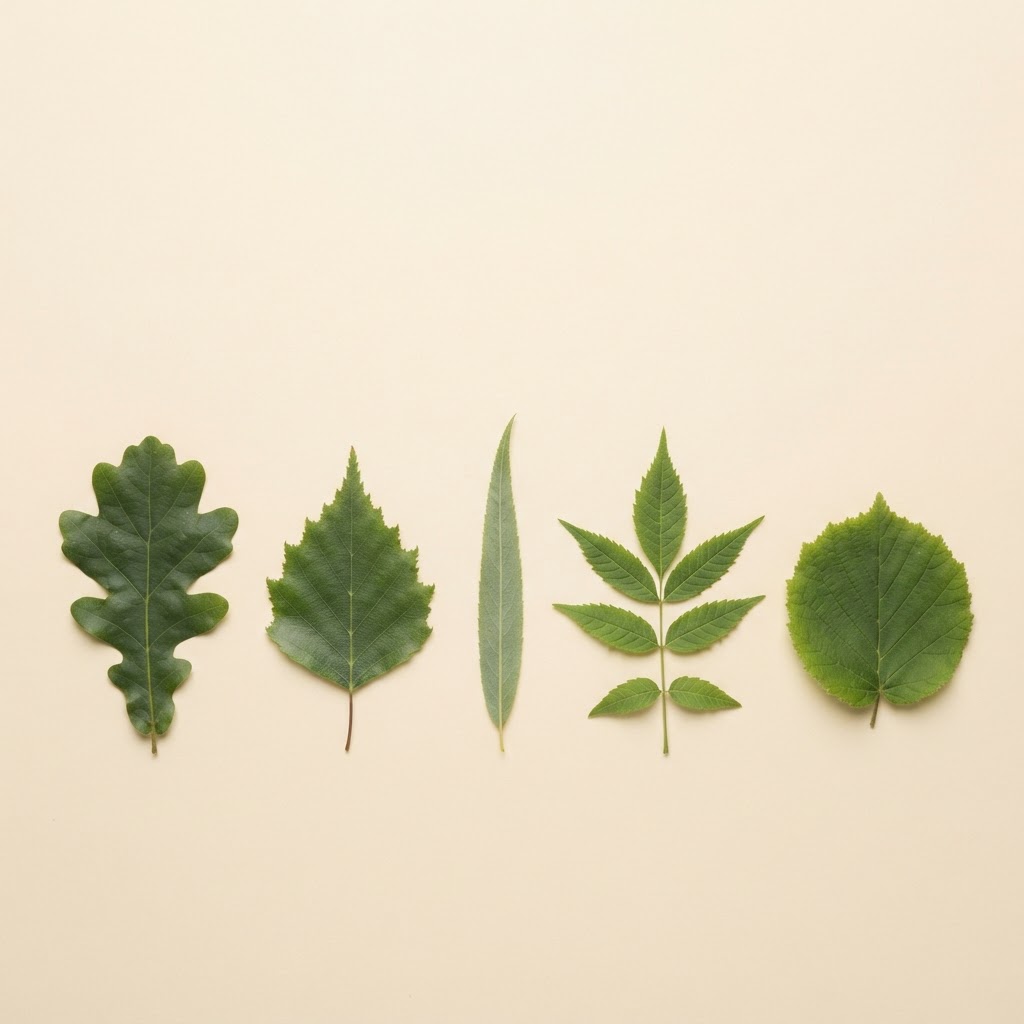
A leaf is the most useful thing you can photograph for plant identification, and the most commonly photographed badly. Most people take a photo of a leaf from arm's length, at an angle, in dappled shade, and then wonder why the app gave a vague answer.
The good news is that fixing this takes about ten seconds of care, and it improves results dramatically.
The Features That Matter
Leaf identification comes down to five features. A good app reads all five; you can learn all five.
- Structure. Simple — one blade per stalk. Compound — multiple leaflets on one stem. This is the first and biggest filter.
- Shape. Round, oval, lance-shaped, heart-shaped, lobed, needle-like.
- Edge. Smooth, toothed, doubly toothed, spiny, lobed.
- Arrangement. Alternate, opposite, or whorled along the stem.
- Veins. Pinnate — branching off a central midrib. Palmate — radiating from one point. Parallel — running the length of the leaf, as in grasses.
There are secondary features that help when the first five are ambiguous: leaf surface texture, hairs, scent when crushed, and whether the leaf has a stalk or attaches directly to the stem.
Simple vs Compound: The Key Test
This trips up more people than anything else, and the fix is simple.
Look for a bud where the leaf stalk meets the twig. If there is a bud at that junction, the entire structure is one leaf and the parts are leaflets. Leaflets do not have buds at their base.
So an ash leaf, which has seven leaflets on a stem, is actually one compound leaf — and the bud is at the base of the whole structure, not at each leaflet. Get this wrong and your identification will be wrong, because you will be describing a leaflet as if it were a leaf.
Our guides to nut tree identification by leafand chestnut leaf identification show the test in practice.
How to Photograph a Leaf
- Pick it or find a low one. A leaf on a branch six metres up will photograph poorly no matter how good your camera is.
- Lay it flat. On a plain surface, or hold it flat in your palm. Curled or folded leaves hide the shape.
- Fill the frame. The leaf should occupy most of the image. Crop in rather than photographing from a distance.
- Use even, diffuse light. Open shade or an overcast day. Direct sun creates blown highlights and deep shadows that destroy the vein pattern.
- Include the twig. Showing how the leaf attaches confirms arrangement, which is one of the five key features.
- Photograph the underside. The reverse is often differently coloured or hairy, and that helps.
- Include a scale. A coin or your finger beside the leaf. Size matters.
Why Some Leaves Are Hard
Grass-like leaves. Grasses, sedges and rushes have long, narrow, parallel-veined leaves that look similar across hundreds of species. Identification usually depends on the flower head, not the leaf.
Eucalypts. Many species have similar sickle-shaped leaves, and identification often requires buds, fruit and juvenile foliage. Adult leaves alone are frequently insufficient.
Conifers. Needles vary in length, arrangement and how many are bundled together, but within a genus the differences are subtle. Counting needles per bundle and checking whether they are arranged singly, in pairs or in whorls is essential.
Juvenile foliage. Many plants have completely different juvenile leaves. Macadamia seedlings have spiny leaves; mature trees have smooth ones. Ivy is the classic example — juvenile ivy has lobed leaves and climbs, mature ivy has unlobed leaves and flowers.
Leaves You Should Not Touch
A practical warning. Some plants cause contact dermatitis, and identification apps cannot warn you before you have already handled the leaf.
- Giant hogweed. Sap causes severe photosensitive burns. Do not handle.
- Stinging nettles. Obvious, but worth knowing the leaf shape — opposite, toothed, with a pointed tip.
- Poison ivy and relatives. Leaves in threes, and the oil causes a persistent rash.
- Euphorbias. Milky sap that irritates skin and eyes.
- Oleander. All parts are toxic, and the sap can irritate skin.
If you are not sure what something is, photograph it in place rather than picking it. That is a good habit regardless.
Learning to Read Leaves
The value of using an identification tool is not the answer — it is the pattern. A good tool tells you which features it used, and after a few dozen leaves you will start seeing the structure yourself.
Start with the common trees in your own street. Learn one properly each week — the leaf shape, the edge, the arrangement, the bark. Within a season you will recognise most of what you walk past, which is a genuinely satisfying thing to be able to do.
The Short Version
Photograph a leaf flat, filling the frame, in even light, with the twig visible and something for scale. Check structure first by looking for a bud at the base of the stalk. Then shape, edge, arrangement and vein pattern. Those five features will identify most plants, and learning them is more valuable than any app.
Frequently Asked Questions
Lay the leaf flat, fill the frame with it, use even diffuse light rather than direct sun, include the twig so the arrangement is visible, photograph the underside, and add something for scale.