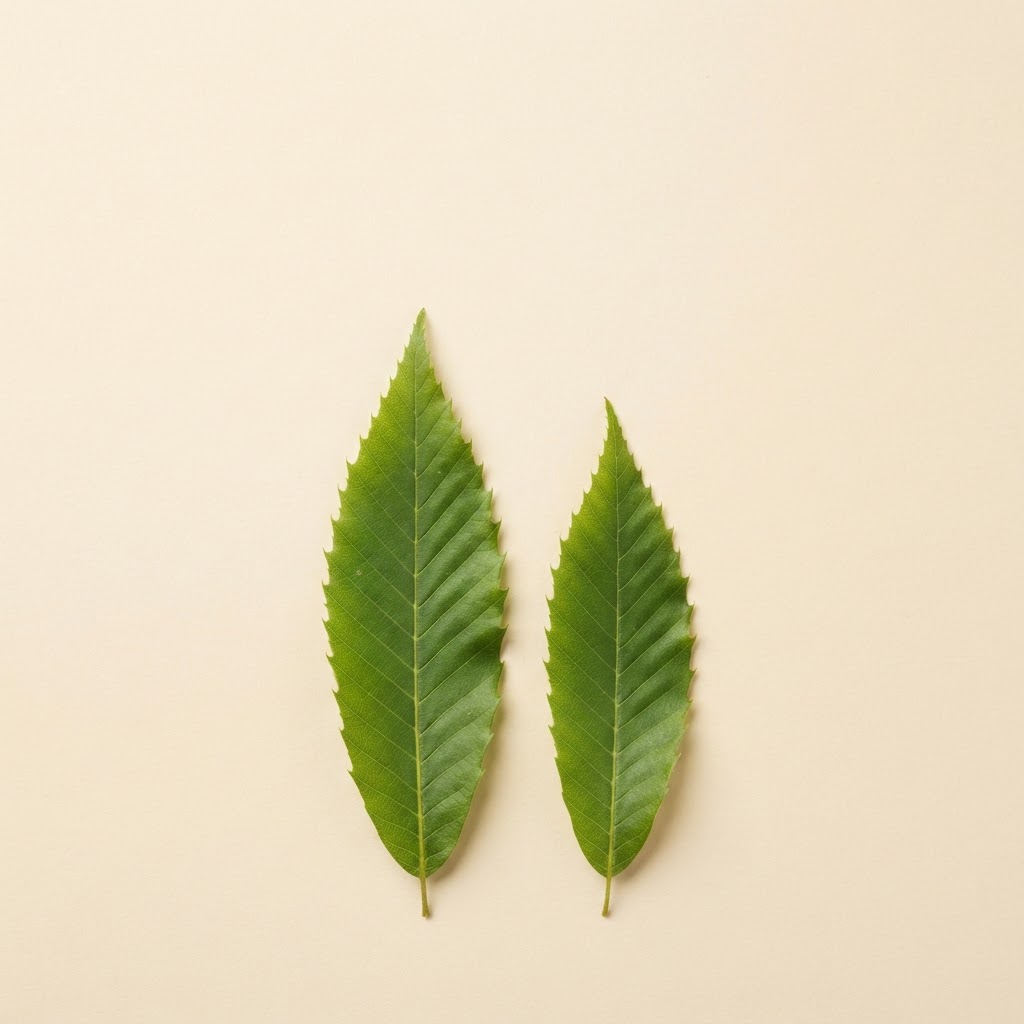
Leaves are the most useful way to identify a chestnut tree, because they are present for six months of the year and the difference between the edible and toxic species is structural rather than subtle. Once you have seen the two side by side, you will never confuse them again.
The Core Distinction
There are two broad leaf patterns in trees, and chestnuts fall on opposite sides of the divide.
A simple leaf is a single blade attached to the stem by a stalk. If you trace the edge of the blade, you never cross onto another leaflet. Sweet chestnut has simple leaves.
A compound leaf is made of multiple leaflets on a single stem. If you trace the edge, you reach the end of one leaflet and then there is a gap before the next. Horse chestnut has palmately compound leaves — the leaflets all radiate from one point at the end of the stalk, like fingers on a hand.
That is the whole test. Sweet chestnut: one blade. Horse chestnut: five to seven leaflets fanning from a central point.
Sweet Chestnut Leaves in Detail
- Shape. Elongated and narrow, tapering to a point — roughly lance-shaped, and much longer than wide.
- Length. Typically 15 to 25 centimetres, which is long for a simple leaf and quite distinctive.
- Edge. Sharply toothed, with prominent pointed teeth that curve slightly toward the tip. The teeth are deep and clearly visible.
- Arrangement. Alternate — leaves attach one at a time along the stem, not in pairs opposite each other.
- Veins. Each tooth has a vein running to it, so the venation is very regular and parallel, creating a neat herringbone pattern.
- Surface. Glossy, deep green above with a slightly leathery feel; paler and faintly hairy beneath.
- Autumn colour. Turns a warm golden-yellow before falling.
That combination — long, narrow, simple, sharply toothed, with parallel veins running to each tooth — is hard to mistake for anything else in a temperate garden.
Horse Chestnut Leaves in Detail
- Structure. Palmately compound — five to seven leaflets, occasionally more, all attached at the same point at the end of the leaf stalk.
- Leaflet shape. Each leaflet is broadest toward the tip and narrows toward the base — obovate. This is unusual and quite recognisable.
- Leaflet size. Each leaflet is roughly 10 to 20 centimetres long, so the whole leaf is large.
- Edge. Doubly toothed — each main tooth has smaller teeth along it, giving a slightly ragged appearance.
- Veins. Prominent and deeply impressed, creating a strongly textured surface.
- Arrangement. Opposite — the leaves sit in facing pairs along the branch.
- Autumn colour. Turns a rich orange-brown, often with a rusty patch before the rest of the leaf follows.
The obovate leaflet shape — widest at the far end — is the detail that confirms horse chestnut even when you cannot see the whole leaf.
Comparison Table
| Feature | Sweet chestnut | Horse chestnut |
|---|---|---|
| Leaf type | Simple | Palmately compound |
| Leaflets per leaf | One | Five to seven |
| Shape | Long, narrow, lance-shaped | Broadest at the tip |
| Edge | Sharply toothed | Doubly toothed |
| Arrangement | Alternate | Opposite |
| Length | 15–25cm | Whole leaf up to 30cm |
The Leaf Scar Test in Winter
Once the leaves have fallen, look at the scar they leave behind on the twig. The shape of the leaf scar is characteristic for many tree species and survives all winter.
Sweet chestnut leaf scars are relatively small and roughly semi-circular, with a distinct horseshoe pattern of bundle scars inside. Horse chestnut leaf scars are large and shield-shaped, often nearly as wide as the twig itself, and very conspicuous.
If you find a twig with a big shield-shaped scar and a large sticky bud above it, you have a horse chestnut.
Other Trees With Similar Leaves
A few other species get confused with chestnuts.
Oaks. Some oak leaves are long with lobed or toothed edges, but oak teeth are usually rounded rather than sharply pointed, and the lobes are deeper. Oaks also produce acorns, which look nothing like chestnuts.
Beech. Beech leaves are simple and toothed with parallel veins, but they are much shorter — around 7 to 10 centimetres — and have a distinctive silky fringe along the edge when young.
Birch. Birch leaves are also simple, toothed and parallel-veined, but they are roughly triangular or diamond-shaped rather than long and narrow, and much smaller.
For the broader picture, our guide to identifying nut trees by leaf compares the whole group side by side.
The Short Version
Sweet chestnut leaves are simple: one long, narrow, sharply toothed blade per stem, 15 to 25 centimetres, arranged alternately with parallel veins running to each tooth. Horse chestnut leaves are palmately compound: five to seven obovate leaflets radiating from one point, arranged in opposite pairs. Only the sweet chestnut is edible.
Frequently Asked Questions
Sweet chestnut leaves are simple, 15 to 25 centimetres long, narrow and lance-shaped, with sharply pointed teeth and parallel veins running to each tooth. They alternate along the stem.