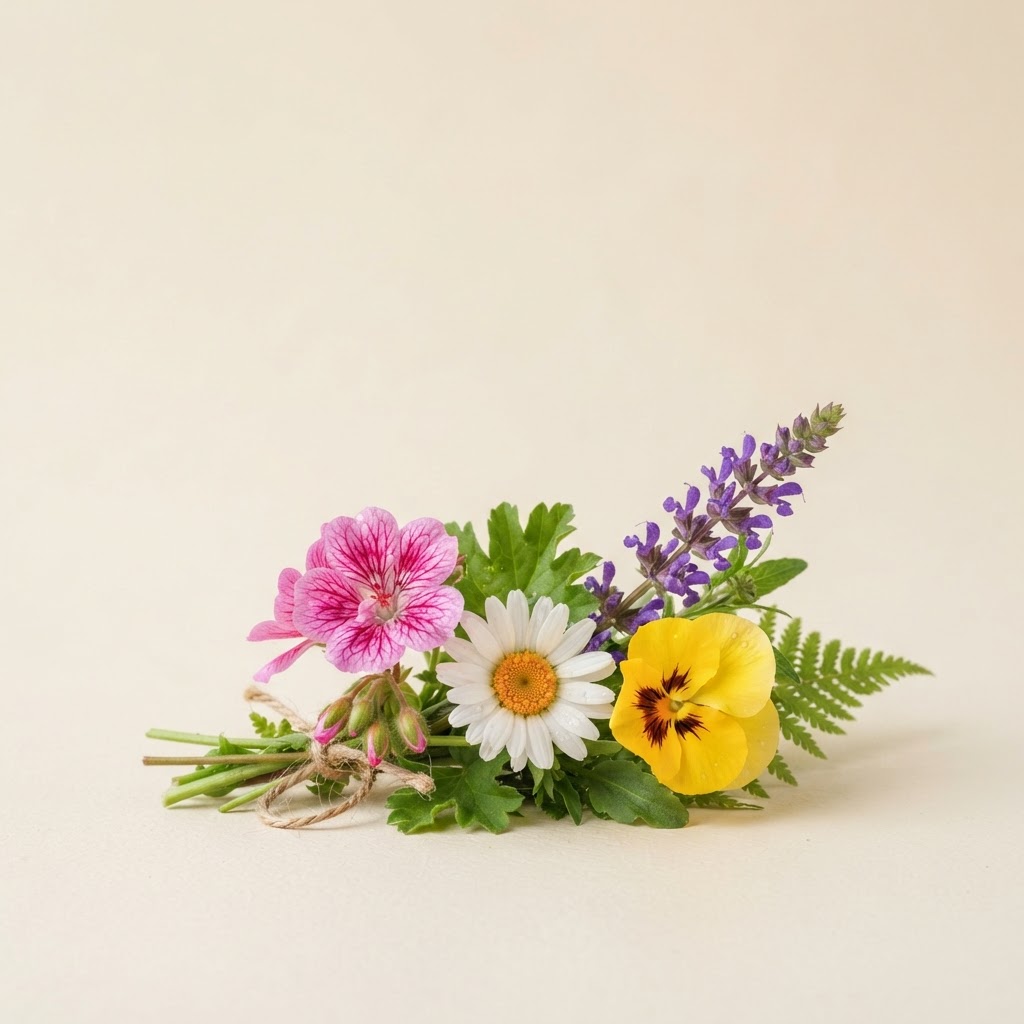
Plant identification used to mean carrying a field guide and working through a key, one feature at a time. That still works, and for anything you intend to eat it is still the gold standard. But for the everyday question — what is that plant growing by the fence — a photo and an AI model will get you an answer in seconds.
The catch is that AI identification is only as good as the photo you give it. This guide covers what to capture and how to sanity-check the answer.
What to Photograph
Most failed identifications come from a single photo of a flower taken from a standing height. Three shots do almost all the work:
- The flower, from the front and the side. The front shows petal number, colour and arrangement. The side shows whether the flower is a trumpet, a bell, a spike or a flat disc — and that shape is often more diagnostic than colour.
- A single leaf, laid flat. Show the edge, the tip, the base and where it joins the stem. Leaf arrangement — alternate, opposite or whorled — is one of the most reliable features in the whole plant kingdom.
- The whole plant in its setting. Height, habit, whether it is a shrub or a herb, whether it is climbing, and what is growing around it.
If you can only take one photo, take the leaf. Leaves are present longer than flowers and carry more structural information. Flowers are more distinctive but seasonal.
The Features That Actually Decide an ID
When you look at a plant, these are the things worth noting. They are also the things an AI model is looking at.
| Feature | What to note |
|---|---|
| Leaf arrangement | Alternate, opposite, or whorled around the stem |
| Leaf edge | Smooth, toothed, lobed, or deeply divided |
| Leaf shape | Oval, lance-shaped, heart-shaped, needle-like |
| Flower structure | Petal number, symmetry, whether petals are fused |
| Flower arrangement | Single, spike, umbel, head, or raceme |
| Stem | Woody or soft, square or round, hairy or smooth |
| Habit | Tree, shrub, herb, climber, grass-like |
| Smell | Crush a leaf — many families are distinctive |
Stem shape is underused. The mint family has distinctly square stems, which is why so many culinary herbs — basil, mint, oregano, sage, rosemary — feel angular when you roll the stem between your fingers. That one check places a huge number of garden plants.
Photography Tips That Make a Real Difference
- Use daylight, not flash. Flash washes out petal detail and creates harsh shadows that hide leaf texture.
- Fill the frame. A flower occupying a tenth of the image gives the model very little to work with.
- Get the leaf in focus. A sharp leaf beats a soft flower.
- Include something for scale. A coin, a finger, or a ruler.
- Photograph the underside. Leaf undersides differ in colour and hairiness and often decide the answer.
- Avoid backlighting. Shooting into the sun turns leaves into silhouettes and loses all colour information.
AI Identification vs a Field Guide
Both have their place, and knowing the limits of each matters.
AI identification is fast and gets you to a family or genus reliably. It struggles with species that look alike, with plants photographed out of flower, and with anything rare or regional. It also has a tendency to sound confident when it should not be — which is why every result from the tool above carries a confidence score.
A field guide is slower but more rigorous. A proper key forces you to check feature after feature, which is why it is the right approach for anything you intend to eat, or for recording a genuinely interesting find.
The sensible combination is to use AI for a fast first answer, then confirm anything important against a reference or a local plant group.
Safety: The Line That Should Never Move
Plant identification has a safety dimension that bird or rock identification does not. Getting it wrong can make you seriously ill.
- Never eat a wild plant based on an app alone. Not a leaf, not a berry, not a mushroom. Confirm with an expert or a proper key.
- Mushrooms are the highest-stakes group. Several deadly species closely resemble common edible ones, and the consequences of an error are severe.
- Be careful with garden plants too. Many common ornamentals are toxic, including oleander, lantana, angel's trumpet and castor oil plant.
- Watch children and pets. Ornamental berries and seeds are a common cause of poisoning in both.
If you are identifying plants in order to forage, our berry identification guide covers the lookalikes that catch people out, and the mushroom guide covers the fungal side properly.
Common Garden Plants and What They Are
A large share of the plants people photograph turn out to be a small number of common species. If you are looking at a shrub with purple flowers in a suburban front yard, it is often a hibiscus, a bougainvillea or a frangipani. If it is a leafy indoor plant, it is often a monstera, a pothos or a peace lily.
Knowing the common options helps you sanity-check an identification. If an app tells you that the plant in a pot on your kitchen bench is a rare alpine species, that is a sign the model has over-reached.
The Short Version
Photograph the flower from two angles, a single leaf laid flat, and the whole plant. Note leaf arrangement, leaf edge, flower structure and stem shape — those four features decide most identifications. Use AI for a fast answer, a field guide for anything you intend to eat, and never trust an app alone when the stakes involve your liver.
Frequently Asked Questions
Photograph the flower from the front and side, a single leaf laid flat showing its edge and attachment, and the whole plant. AI identification works best with all three, and the leaf alone is the most useful if you only take one shot.