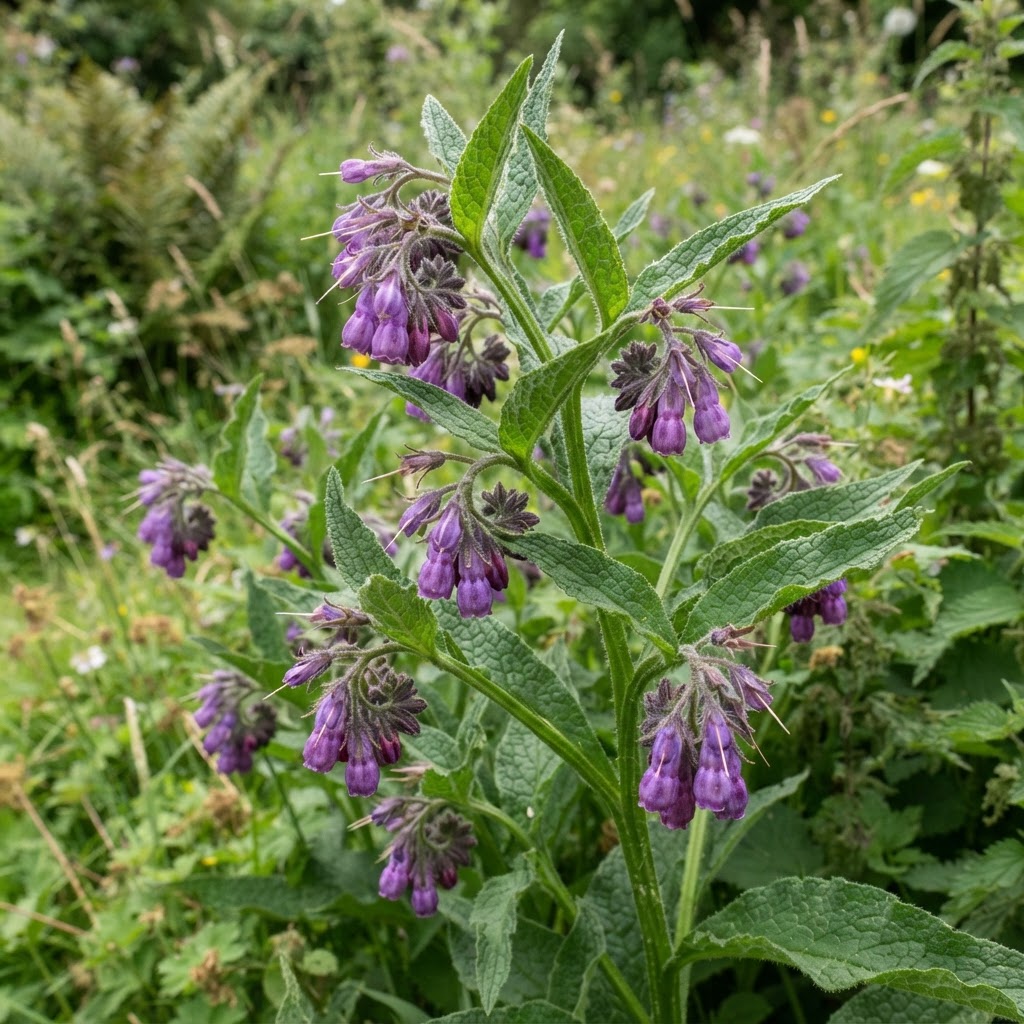
Comfrey is a plant with a split reputation. Gardeners grow it as a dynamic accumulator and a compost activator. Herbalists have used it topically for centuries. Regulators have restricted it for internal use. And it has a genuinely dangerous lookalike that grows in the same places.
If you are going to have comfrey in your garden, it is worth being certain about the identification.
What Comfrey Looks Like
Common comfrey — Symphytum officinale — is a robust herbaceous perennial in the borage family. It dies back to the ground each winter and returns vigorously in spring from a thick, deep taproot.
- Leaves. Long, lance-shaped to oval, up to 40cm on a well-grown plant. Dark green and distinctly coarse.
- Leaf texture. Covered in stiff, bristly hairs that make the leaf feel rough and slightly prickly. This is the most reliable single feature.
- Stem. Thick, upright, and often winged — the leaf tissue continues down the stem as a ridge rather than stopping at the joint.
- Flowers. Bell-shaped or tubular, in drooping clusters that curl over at the tip like a fiddlehead. Colours range from cream through pink to purple, often on the same plant.
- Height. Usually 60–120cm when flowering.
- Root. Fleshy, black on the outside, white inside, and brittle — a fragment left in the ground will regrow.
The drooping, curled flower clusters are a strong clue. Comfrey flowers hang downward in a scorpion's tail arrangement, not upright on a spike.
The Dangerous Lookalike: Foxglove
Before it flowers, comfrey can be confused with foxglove (Digitalis purpurea), and that confusion matters. Foxglove is toxic in every part, and its cardiac glycosides can cause serious illness or death.
| Feature | Comfrey | Foxglove |
|---|---|---|
| Leaf hairs | Stiff, bristly, prickly to touch | Soft, downy, velvety |
| Leaf base | Stops at the stem, or wings down slightly | Clearly runs down the stem (decurrent) |
| Leaf veins | Less pronounced | Strongly impressed, giving a quilted look |
| Flowers | Bell-shaped, drooping, curled clusters | Tubular, upright spikes, spotted inside |
| Flower colour | Cream, pink, purple | Purple, pink, white |
| Throat of flower | Open | Spotted with dark marks, often with a white ring |
| Height in flower | Up to about 1.2m | Up to 2m |
The tactile difference is the fastest test. Comfrey is rough and bristly and slightly unpleasant to stroke. Foxglove is soft and velvety, like the ear of a dog.
Once either plant flowers, there is no confusion at all. Foxglove puts up a tall one-sided spike of tubular bells with speckled throats. Comfrey droops its bells downward in tight, curling clusters.
Other Plants Called Comfrey
Russian comfrey (Symphytum × uplandicum). A hybrid between common comfrey and rough comfrey, and the one most often grown in gardens as a mulch crop. It is taller and more productive than common comfrey, and it rarely sets seed. Its leaves are slightly narrower.
Borage (Borago officinalis). A close relative and also hairy, but borage has brilliant blue, star-shaped flowers that face outward and upward rather than hanging bells. The leaves are more oval and the plant is annual, not perennial.
Green alkanet (Pentaglottis sempervirens). Another borage-family plant with coarse hairy leaves. It has bright blue flowers with a white centre, held in flat-topped clusters rather than drooping bells.
The Safety Position on Comfrey
Comfrey contains pyrrolizidine alkaloids, a group of compounds that can damage the liver when taken internally. The concern is not about a single leaf in a salad — it is about cumulative exposure, particularly from concentrated root preparations taken over months.
Regulators in several countries have restricted or banned oral comfrey products for this reason. Topical use of comfrey leaf or root on unbroken skin has a much longer history and a different risk profile, but it is still something to discuss with a health professional rather than take on the strength of a blog post.
The practical takeaway for a gardener: comfrey is a superb plant to grow, mulch with and compost, and a poor choice to eat. Keep it out of the salad bowl and away from anyone who might mistake it for spinach.
Growing Comfrey as a Garden Plant
Comfrey's deep taproot reaches nutrients that shallow-rooted plants cannot, and its leaves break down quickly into a potassium-rich mulch. That combination makes it one of the most useful plants in a productive garden.
A few things to know before you plant it. It is difficult to remove — every fragment of root left behind will regrow, so choose the site carefully and do not rototill it. It spreads by root division rather than seed in most garden forms, so it tends to stay in one place. And it will happily reach well over a metre across within two or three seasons.
Plant it somewhere you do not mind it staying: a corner of the garden, along a fence, or under fruit trees. Cut it three or four times a season and use the leaves as mulch, in compost, or steeped in water as a liquid feed.
If you are sorting out the plants in a productive garden, our vegetable leaf scanner guide and the broader plant and flower identification guide cover the rest of the group. And if you are working out what has appeared by itself, the weed identifier guide is the right starting point.
Frequently Asked Questions
Comfrey has long, lance-shaped leaves covered in stiff bristly hairs that feel rough to touch, thick stems that are often winged, and drooping curled clusters of bell-shaped flowers in cream, pink or purple.