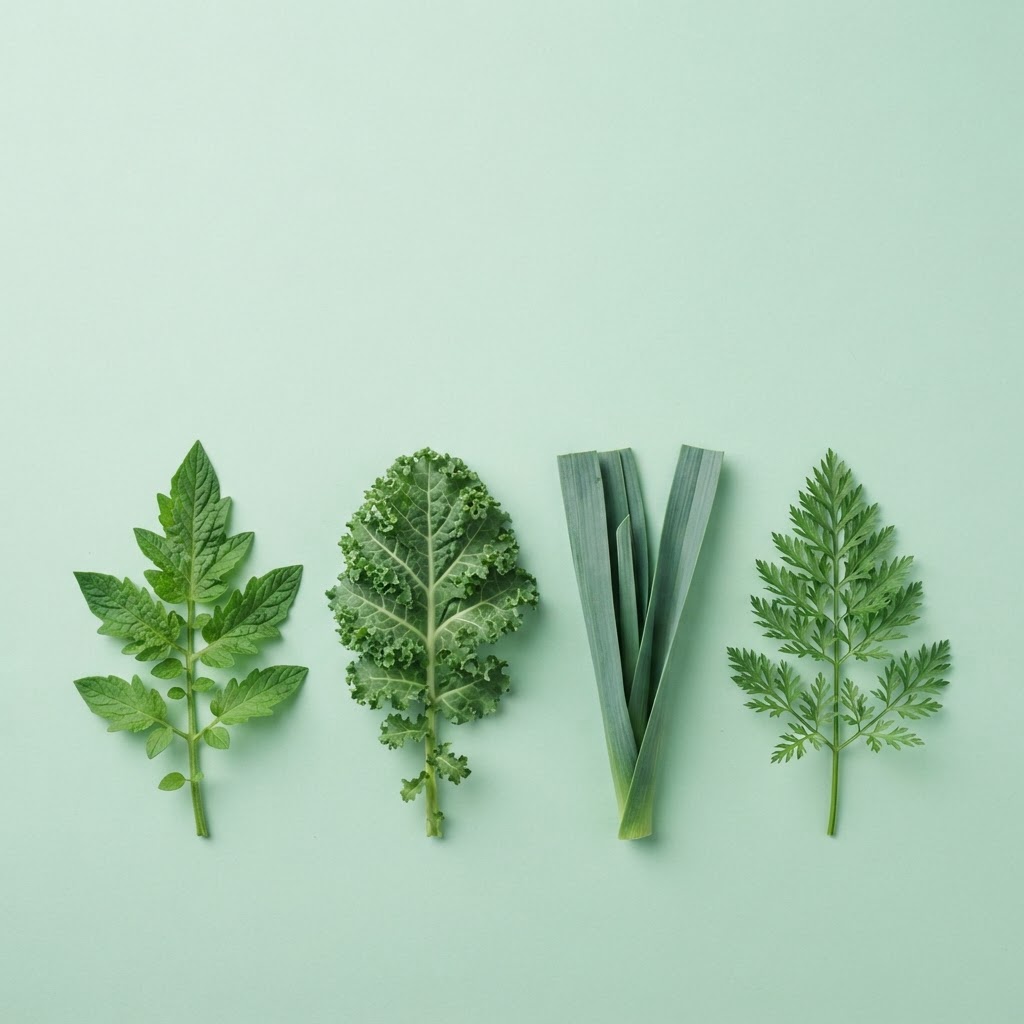
Leaf identification is the most useful skill in a vegetable garden, for two reasons. The first is the obvious one — knowing what you planted. The second matters more: telling your vegetables apart from the weeds that appear around them, and knowing which self-sown seedlings to keep.
Vegetable leaves fall into a small number of recognisable types. Learn the types and you can identify most garden plants before they have produced anything edible.
The Main Leaf Types
| Leaf type | What it looks like | Vegetables |
|---|---|---|
| Lobed or divided | Deeply cut into lobes or leaflets | Tomato, potato, capsicum, eggplant, carrot |
| Broad and crinkled | Wide blade with a wavy or ruffled surface | Cabbage, kale, silverbeet, spinach, broccoli |
| Strap-like | Long, narrow, upright, often hollow | Onion, garlic, leek, spring onion |
| Feathery | Finely divided, thread-like | Carrot, dill, fennel, parsley |
| Heart or arrow shaped | Pointed with a notched base | Sweet potato, silverbeet (young), beans |
| Round or kidney shaped | Broad, flat, smooth-edged | Beans, peas, broad beans |
| Long and grassy | Narrow with parallel veins | Sweet corn, lemongrass |
| Simple oval | Oval with a smooth or slightly toothed edge | Beetroot, chard, lettuce |
The Nightshade Group
Tomato, potato, capsicum and eggplant are all in the nightshade family, and their leaves share a family resemblance — deeply lobed or divided, with a distinctive smell when crushed. Tomato leaves smell sharp and green; potato leaves are similar but milder.
Be aware that nightshade foliage is not edible. Tomato and potato leaves contain solanine and should never be eaten, which is worth knowing because people occasionally ask. The fruit and tubers are fine; the leaves are not.
Capsicum and eggplant leaves are simpler than tomato — more oval with wavy edges rather than deeply cut. Our pepper plant identification guidecovers that group in detail.
The Brassica Group
Cabbage, kale, broccoli, cauliflower, brussels sprouts, bok choy and rocket are all brassicas, and their leaves share a broad, often wavy or crinkled blade with a distinct blue-green or grey-green tone. Broccoli and cauliflower leaves in particular are large, coarse and unmistakable once you have seen them — they look like a big, loose cabbage leaf.
Young brassica seedlings are one of the most common sources of garden confusion, because they look like a range of common weeds in the mustard family. This is not a coincidence: the weeds are often brassicas too. The four-petal cross-shaped flower is the family marker — if you let a brassica go to seed, it produces small yellow flowers with four petals.
The Allium Group
Onion, garlic, leek, shallot and spring onion all produce long, narrow, strap-like leaves with parallel veins. The leaves are often hollow and have a distinct onion smell when crushed, which settles the identification immediately.
Garlic leaves are flatter and more solid than onion leaves. Leek leaves are broad and flat with a distinct keel. Spring onion leaves are thinner and more tubular. If you are unsure, crush one — the onion smell is definitive.
Seedlings: Telling Vegetables From Weeds
This is where leaf identification earns its keep. When a bed is full of small green things, the question is which to pull and which to keep.
- Seed leaves come first. The first pair of leaves a seedling produces look nothing like the mature leaves. They are usually simple ovals and are the same across many species. Wait for the second set — the true leaves — before judging.
- True leaves are diagnostic. The second set looks like miniature versions of the adult leaves. That is when you can identify them.
- Smell is decisive. Crush a leaf. Carrot seedlings smell of carrot, onion seedlings smell of onion, brassica seedlings smell faintly of cabbage. Weeds mostly smell of nothing in particular.
- Root colour helps. Beetroot and silverbeet seedlings often have reddish stems and veins, which distinguishes them from weeds.
If you are unsure, do not pull it. Leave the seedling for another week and it will usually become obvious. Over-thinning is a more common mistake than under-thinning.
Common Garden Weeds That Mimic Vegetables
- Wild mustard and wild radish: four-petal yellow or white flowers, deeply lobed leaves. Look like young brassicas.
- Fat hen: broad, diamond-shaped leaves with a powdery white coating on young growth. Common in disturbed soil.
- Purslane: thick, fleshy, reddish stems with small rounded leaves. Edible, but it competes with your crops.
- Chickweed: tiny star-shaped white flowers and small oval leaves. Very common in cool-season beds.
- Sow thistle: deeply lobed leaves with a milky sap. The sap is the giveaway — most vegetable seedlings do not bleed milk.
If you are identifying weeds deliberately rather than incidentally, our weed identifier guide covers that in more detail.
Leaf Problems Worth Recognising
A scanner is also useful for diagnosing problems, because leaf symptoms follow recognisable patterns.
- Yellowing between veins: usually a nutrient deficiency, most often iron or magnesium.
- Yellowing of older leaves first: usually nitrogen deficiency.
- Purple-tinged leaves: often phosphorus deficiency, or cold stress in seedlings.
- White powdery coating: powdery mildew, a fungal disease encouraged by poor airflow.
- Holes with ragged edges: caterpillar or slug damage.
- Mottled yellow and green: often a virus, spread by sap-sucking insects.
For general produce freshness, our vegetable freshness guide covers what to look for at the shop, and this piece has the universal tests.
The Short Version
Lobed leaves mean nightshades. Broad crinkled leaves mean brassicas. Strap-like leaves mean alliums. Feathery divided leaves mean carrot or dill. For seedlings, wait for the true leaves, then crush one and smell it — that is more reliable than appearance for anything small and green.
Frequently Asked Questions
Start with leaf shape. Deeply lobed leaves usually mean tomato, potato, capsicum or eggplant. Broad crinkled leaves mean cabbage, kale or broccoli. Long strap-like leaves mean onion, garlic or leek. Feathery divided leaves mean carrot or dill.