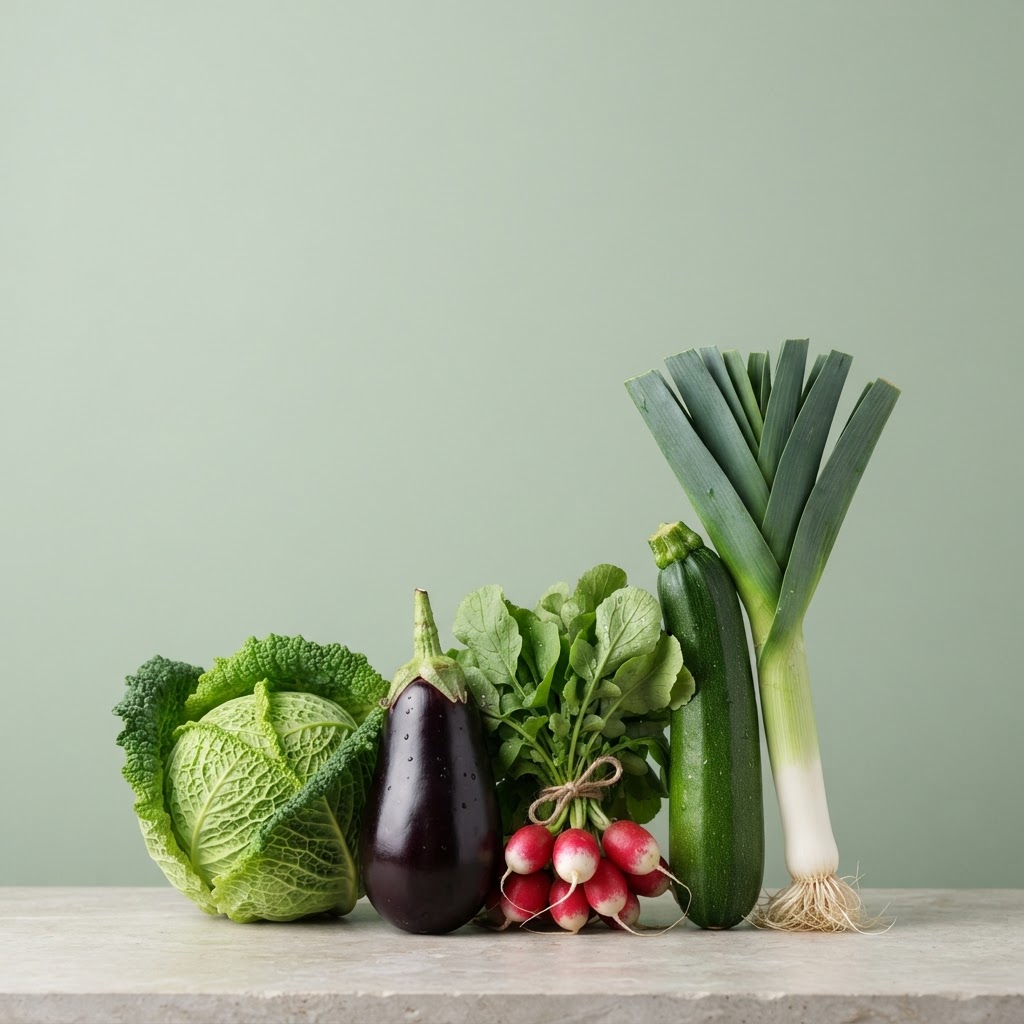
Vegetable apps fall into two groups, and the difference between them is enormous. The first group is plant identifiers with a vegetable section bolted on. The second is kitchen tools that help you actually deal with vegetables — buying them, storing them, and cooking them before they turn.
Which you need depends on where your problem is. If you keep buying unfamiliar produce at a farmers market and never know what to do with it, you want the first. If your crisper drawer is where vegetables go to die, you want the second.
Job One: Identifying What You Have
Vegetable identification is genuinely harder than fruit identification, for a simple reason. Fruit is usually photographed whole and in season. Vegetables arrive in the kitchen in pieces — topped, peeled, chopped, or as a leaf with no fruit attached at all.
A good vegetable app handles that. It should work from a leaf, a root, a seedling or a whole plant, and it should tell you which features it used so you can learn. Our guides to identifying vegetables by their leaves and identifying root vegetables cover what to photograph.
It also needs to handle the genuinely confusing cases. Bitter melon and cucumber. Parsley and coriander. Shallots and spring onions. Swede and turnip. These are the pairs people actually get wrong, and a tool that can separate them is more useful than one that recognises forty varieties of tomato.
Job Two: Freshness — the Recurring Decision
This is where most vegetable apps are weakest and where the value is highest. Every week, households across the country make the same decision several times: is this still good, or does it go in the bin?
Getting that wrong in either direction costs you. Throw out something perfectly good and you have wasted money. Cook something that has turned and you have wasted a meal. A tool that reads the visible signals — colour, firmness, surface texture, mould — and gives you a straight answer is worth having.
It should also know the safety line. Mould on a firm vegetable can sometimes be cut away with a wide margin. Mould on a soft vegetable means the whole thing goes, because the hyphae have already spread invisibly through it.
Job Three: Cooking It Before It Spoils
This is the job almost every vegetable app ignores, and it is the one that saves money. The vegetables in your fridge are not a shopping list problem, they are a meal problem. You have a courgette, half a cabbage, three carrots and a wilting bunch of spinach, and you need dinner.
A tool that can see those vegetables and suggest meals using only them is solving the real problem. If that is what you are after, look at how a fridge photo becomes recipes.
The other half of this is portioning. Vegetables are wasted in large part because people cook more than they eat. Our portion calculator works out how much to buy and cook per person, which cuts waste at the source.
What to Look For
- Works from partial vegetables. If it needs a whole plant, it will not help in a kitchen.
- Gives a freshness verdict. Identification without a usability call leaves the hard question unanswered.
- Explains its reasoning. Feature lists teach you; bare names do not.
- Handles lookalikes. The confusing pairs matter more than the exotic ones.
- Links to cooking. A name is only useful if it leads somewhere.
The Short Version
A vegetable app earns its place by doing three things: identifying partial vegetables rather than just whole plants, giving a straight freshness verdict on what is already in your fridge, and helping you cook it before it spoils. Naming alone is a novelty.
Frequently Asked Questions
The best one identifies vegetables from partial specimens like leaves and roots, gives a clear freshness verdict, and helps you cook what you have. Apps that only name whole plants leave the useful work undone.