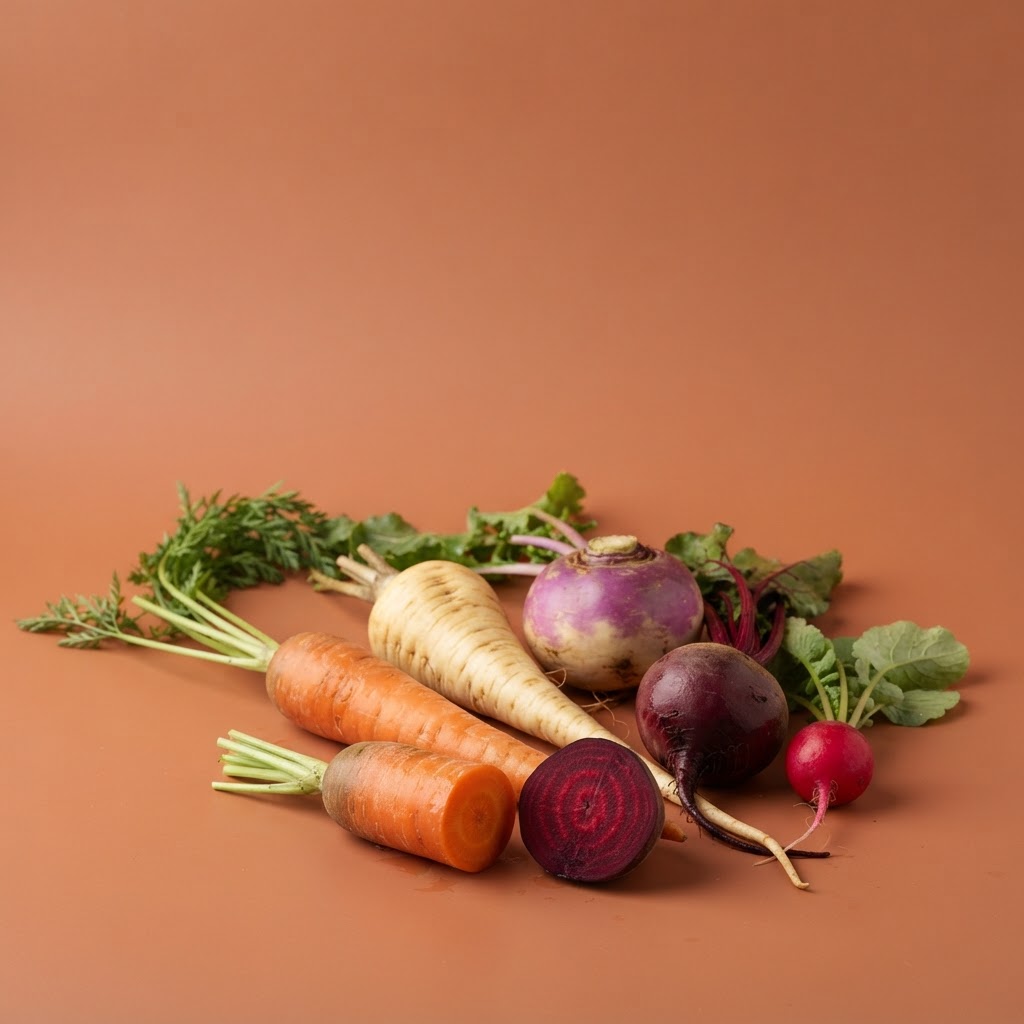
Root vegetables are mostly easy to tell apart at a glance, with two exceptions that catch people out constantly: carrot versus parsnip, and turnip versus swede. There is also one genuine safety issue in this group that is worth knowing about.
The Comparison Table
| Vegetable | Shape | Skin | Flesh |
|---|---|---|---|
| Carrot | Long, tapered | Orange, smooth | Orange, crisp |
| Parsnip | Long, tapered, often broader at the top | Cream to pale tan | Cream, dense |
| Turnip | Round to flattened | Purple-topped, white below | White, crisp |
| Swede | Large, round to oblong | Purple-brown or green-topped | Yellow-orange |
| Beetroot | Round to slightly flattened | Deep red-purple, rough | Deep red-purple |
| Radish | Small, round or elongated | Red, pink, white or black | White, crisp |
| Celeriac | Large, knobbly, irregular | Tan-brown, rough and ridged | Cream, celery-scented |
| Kohlrabi | Swollen stem above ground, round | Pale green or purple | Cream, crisp, mild |
| Sweet potato | Long, irregular, tapered ends | Red, purple, orange or cream | Orange, cream or purple |
| Potato | Round to oblong, irregular | Tan, red or purple | White, cream or yellow |
| Yam | Long, cylindrical, often very large | Rough, scaly, hairy | White, purple or yellow |
Carrot vs Parsnip
This is the pair people get wrong most often, usually because a parsnip has been trimmed and the colour looks ambiguous under shop lighting. Three things settle it.
- Colour. Carrots are orange through and through. Parsnips are cream to pale tan, both skin and flesh.
- Shape. Parsnips are usually wider at the top and taper more sharply. Carrots are more uniformly cylindrical before tapering.
- Smell. Raw parsnip has a distinctly sweet, faintly aniseed aroma. Carrot smells of carrot. Scratch the skin and smell it — this is decisive.
Cooked, they are even easier: parsnip is sweet, nutty and starchy; carrot is sweeter and more carrot-flavoured. Both roast well and both are excellent in a root vegetable traybake.
Turnip vs Swede
These two are genuinely confusing, partly because the naming varies by country. In Australia, swede is the large yellow-fleshed root; in Scotland and parts of the UK it is called neeps or turnip, and the small white one is a turnip.
- Turnip: small, round, usually purple on top and white below. Flesh is white, crisp and peppery. Best eaten young and small.
- Swede: much larger, round to oblong, purple-brown or green-topped. Flesh is yellow-orange and distinctly sweet. Needs cooking.
Size is the easiest separator. If it fits in your palm, it is a turnip. If it needs two hands, it is a swede.
Celeriac and Kohlrabi
These two are oddities because neither is technically a root. Celeriac is a swollen stem base, and kohlrabi is a swollen stem that grows above the ground.
Celeriac looks like a rough, knobbly, tan-brown ball with a mass of small roots around the base and leafy stalks on top. It smells distinctly of celery, which is the giveaway.
Kohlrabi looks like a pale green or purple globe sitting on top of the soil with leaf stalks radiating from its sides. The taste is mild and slightly sweet, somewhere between a turnip and a broccoli stem.
Sweet Potato vs Yam
This one is a genuine naming problem rather than an identification problem. What Australians call a yam in the supermarket is usually a different variety of sweet potato, not a true yam.
True yams have rough, scaly, often hairy skin and can grow to enormous sizes. They are rare in Australian supermarkets. Sweet potatoes have smoother skin and are the familiar orange, cream or purple-fleshed roots. If it is smooth-skinned and labelled yam, it is almost certainly a sweet potato variety.
Sweet potato skin is edible, unlike some root vegetables, and worth keeping — see can you eat sweet potato skin. Potato skin is also edible with one important exception, covered in the potato skin guide.
The Safety Issue: Green Potatoes
This is the one real hazard in the root vegetable group. Potatoes turn green when exposed to light, and the green colour indicates the presence of solanine, a natural toxin.
Solanine is not destroyed by cooking. Small green patches can be cut away generously, but a potato that is significantly green, sprouted or bitter should be discarded entirely. Symptoms of solanine poisoning include nausea, vomiting, diarrhoea and headaches, usually within a few hours of eating.
Store potatoes in a cool, dark place and never in the fridge, where the starch converts to sugar and the texture suffers. Our guide to why potatoes turn green and when old potatoes become unsafe cover the detail.
Storing Root Vegetables
Root vegetables generally store well, which is one of their great advantages. The rules are straightforward.
- Remove leafy tops from carrots, beetroot and turnips before storing. The leaves pull moisture from the root.
- Keep them cool and dark. Potatoes, onions, garlic and winter squash should never go in the fridge.
- Refrigerate the rest. Carrots, parsnips, beetroot, radish and celeriac all keep well in the crisper.
- Keep potatoes away from onions. Onions release compounds that accelerate potato sprouting.
- Do not wash before storing. Surface moisture encourages rot.
Our storage guide covers the specifics for each vegetable, and the food waste guide has strategies for using up a glut before it spoils.
The Short Version
Colour and shape identify most root vegetables immediately. Carrot versus parsnip comes down to colour and smell. Turnip versus swede comes down to size and flesh colour. And the one real hazard is green potatoes, which contain solanine that cooking does not destroy.
Frequently Asked Questions
Carrots are orange through and through; parsnips are cream to pale tan. Parsnips are usually wider at the top and taper more sharply. Scratch the skin and smell it — parsnip has a distinctly sweet, faintly aniseed aroma.