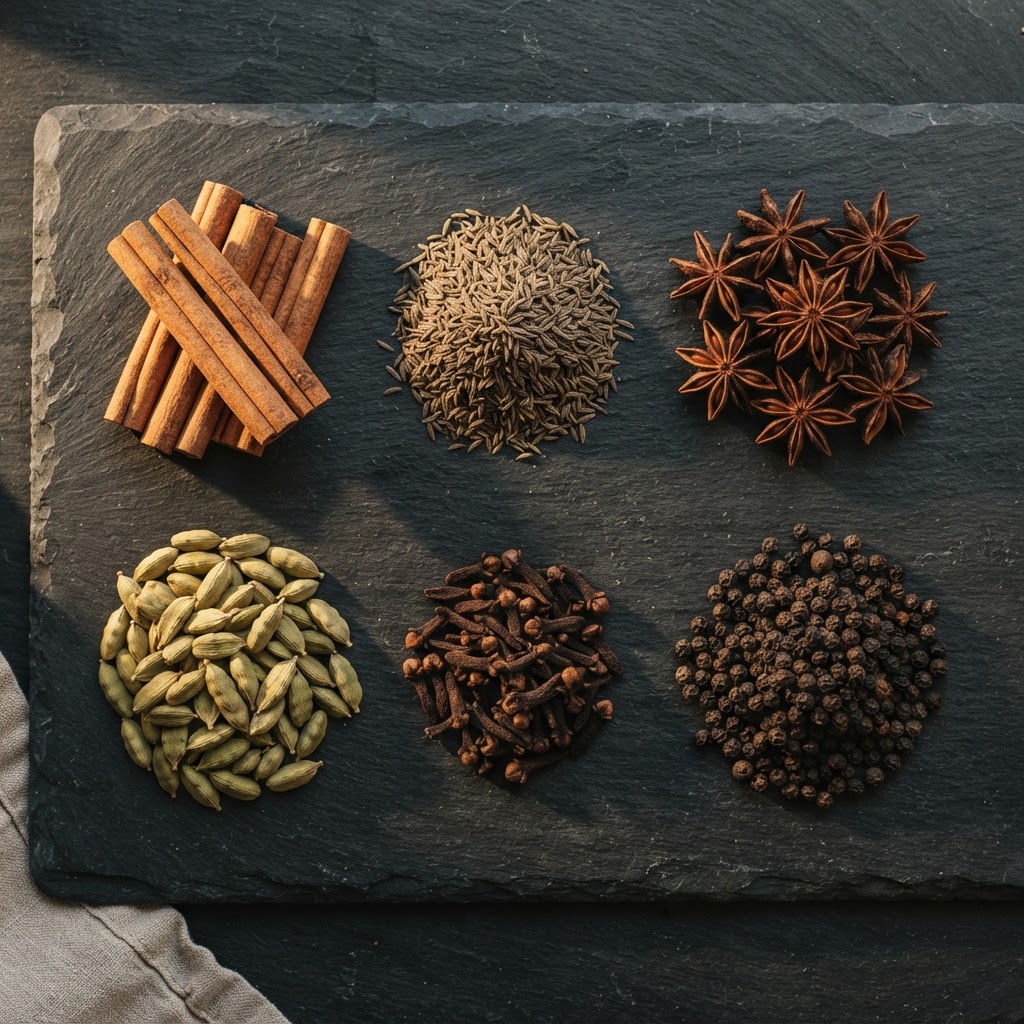
Spices are the hardest thing in the kitchen to identify from a glance and the easiest to identify once you know the handful of features that separate them. The problem is that most of us buy them once, decant them into an unlabelled jar, and then guess for the next three years.
This guide covers the whole spices that actually get confused, and the tests that resolve them.
Shape First, Then Smell
Two checks do most of the work. Shape narrows the field immediately — a star, a crescent, a round ribbed seed and a long thin seed are obviously different things. Then smell confirms it, because spices are almost entirely about aroma and the aromas are distinctive.
A third check is useful when shape and smell disagree: break or crush the spice. Many whole spices release far more aroma when cracked, and some — nutmeg in particular — smell of almost nothing until grated.
Cinnamon vs Cassia
This is the most consequential confusion in the spice drawer, because the two are different species with different chemistry and very different prices, and in many countries both are legally sold as "cinnamon".
| Feature | Ceylon cinnamon | Cassia |
|---|---|---|
| Species | Cinnamomum verum | Cinnamomum cassia |
| Bark thickness | Thin, papery, many layers | Thick, hard, single layer |
| How it rolls | Rolls inward from both sides into a quill | Curls inward from one side only |
| Colour | Light tan | Reddish-brown |
| Texture when snapped | Crumbles easily | Hard and splintery |
| Flavour | Delicate, sweet, complex | Strong, pungent, slightly bitter |
The rolling direction is the giveaway. A Ceylon quill is made from several thin layers rolled together, so if you look at the end you see a spiral that tucks in on both sides. Cassia is one thick piece of bark that curls one way, like a scroll.
Cassia also contains considerably more coumarin, which is why some health authorities recommend limiting regular high intake. For everyday cooking the practical point is simply that they are not interchangeable by volume — cassia is much stronger.
Cumin vs Caraway vs Fennel
Three small brown seeds that end up in the same drawer.
- Cumin. Long, narrow, pale brown, with fine ridges running lengthwise. Warm, earthy, slightly bitter smell. Usually the largest of the three.
- Caraway. Darker brown, distinctly crescent-shaped and curved, with five pale ridges. Sharp anise and dill aroma.
- Fennel seed. Larger and greener than either, with a clear lengthwise ridge pattern. Sweet, clean anise smell.
If the seed smells of anise and is curved, it is caraway. If it smells of anise and is straight and green, it is fennel. If it smells earthy and warm, it is cumin.
Coriander Seed vs White Pepper
Both are small, round and pale, and both end up in the same jar if you are careless.
Coriander seed is tan to light brown, slightly ribbed, and smells citrusy, floral and faintly sweet — nothing like the leaf. It is usually around 3–5mm.
White pepper is the same berry as black pepper, soaked and stripped of its outer skin. It is smaller, smoother, rounder, and smells sharp and pungent with an earthy note. If you cannot decide, crush one — coriander is aromatic and light, pepper makes you want to sneeze.
Peppercorns: Black, White, Green, Pink
Black, white and green peppercorns are all the same plant, Piper nigrum, at different stages of processing. Black is the unripe berry dried in the sun, which darkens the skin. White is the ripe berry with the skin removed. Green is the unripe berry preserved by brine, freeze-drying or sulphur-drying to hold its colour.
Pink peppercorns are not pepper at all. They are the dried berries of a South American tree in the cashew family, with a fruity, resinous flavour and a mild allergen risk for people with nut sensitivities.
Star Anise vs Aniseed vs Fennel
All three taste of anise, so smell alone will not separate them — shape will.
Star anise is a hard, woody, eight-pointed star, usually 2–3cm across, with a single shiny seed in each point. It is the fruit of an evergreen tree and it is not related to aniseed at all.
Aniseed is a small, grey-green, teardrop-shaped seed with fine hairs, about 3mm long.
Fennel seed is larger, greener and ridged lengthwise. Its anise flavour is milder and more vegetal.
Nutmeg and Mace
These are two spices from one fruit. Nutmeg is the seed inside the kernel; mace is the lacy red aril that wraps around it. Nutmeg is warm, sweet and woody. Mace is lighter, more delicate and slightly pepperier. They can be substituted for each other in a pinch, but mace is the subtler of the two.
Whole nutmeg keeps its aroma for years. Ground nutmeg loses most of it within months, which is why grating it fresh makes such a noticeable difference.
Quick Reference
| Spice | Shape | Smell |
|---|---|---|
| Cardamom (green) | Small pale green ribbed pod | Floral, eucalyptus, citrus |
| Cardamom (black) | Larger, dark, wrinkled pod | Smoky, camphor-like |
| Cloves | Nail-shaped, round head | Intense, warm, numbing |
| Fenugreek | Tiny hard amber seeds | Maple syrup, slightly bitter |
| Sumac | Dark red crushed berries | Tangy, lemony, astringent |
| Saffron | Dark red threads | Floral, honeyed, hay-like |
| Turmeric | Bright orange powder or finger | Earthy, mustard-like |
| Paprika | Fine red powder | Sweet, mild, fruity |
Storing Spices So They Stay Identifiable
A spice you cannot identify is usually a spice that has lost its aroma. Whole spices keep for two to four years in a cool, dark cupboard; ground spices are best within six months to a year. Heat, light, moisture and air are the enemies, which is why the rack above the stove is the worst place in the kitchen for them.
Label everything, including the date. When a jar becomes anonymous, the cheapest fix is to replace it — an old spice contributes almost nothing to a dish anyway.
Cooking with more spices is one of the simplest ways to increase the variety in your diet. Our guide to what counts as a plant point explains how herbs and spices count toward weekly plant diversity, and the 30 plants a week tracker lets you keep score.
Frequently Asked Questions
Ceylon cinnamon is thin and papery with many layers, rolls inward from both sides into a quill, is light tan, and crumbles when snapped. Cassia is thick, hard, curls inward from one side only, is reddish-brown and splinters rather than crumbling.