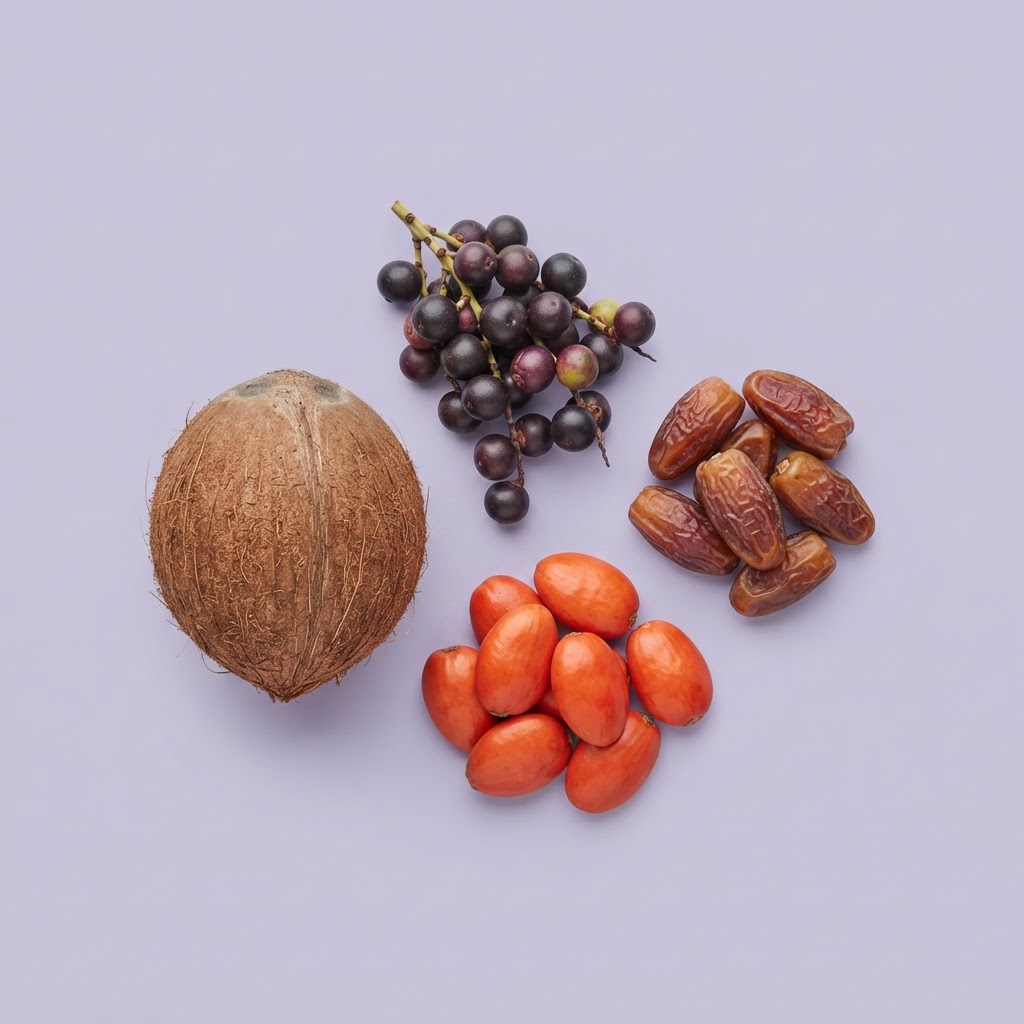
Palms are one of the easiest plant families to recognise and one of the hardest to identify within. Almost all of them have a straight, unbranched trunk with a crown of large leaves at the top, and almost none of them have any feature you can examine without a ladder.
The good news is that the fruit is often the most accessible part, and it is also the part that matters. Start there.
Two Leaf Types Divide the Family
Before anything else, look at the leaves.
- Feather-like (pinnate). Many leaflets arranged along a central stem, giving a frond that looks like a feather. Coconut, date, acai, oil palm, queen palm, jelly palm.
- Fan-shaped (palmate). Leaflets radiating from a single point, giving a circular fan. Sabal, Washingtonia, and many of the hardy landscape palms.
Most of the fruit-bearing palms people care about are in the feather group, so a fan-shaped leaf usually means the fruit is not going to be anything you want.
The Trunk Tells You a Lot
A coconut palm has a smooth, often curved trunk with faint ring scars. Date palms have heavily textured trunks covered in the diamond-shaped bases of old leaves. Many ornamental palms keep their old leaf bases as a fibrous skirt. The trunk is a useful secondary clue, especially when there is no fruit.
Palm Fruits Compared
| Palm | Fruit | How it clusters | Edible? |
|---|---|---|---|
| Coconut | Very large, fibrous husk, three eyes | Few, hanging among the leaves | Yes |
| Date | Small, sweet, thin skin | Long hanging strands | Yes |
| Acai | Small, dark purple, thin flesh | Large branching panicles | Yes, processed |
| Oil palm | Orange-red, oily | Dense heavy bunches | Not eaten directly |
| Jelly palm (Butia) | Yellow-orange, fibrous | Long hanging clusters | Yes, for jelly |
| Queen palm | Orange, small, single seed | Long hanging clusters | Technically, but not worth it |
| Betel or areca | Small, hard, orange | Dense bunches | Carcinogenic when chewed |
The One That Matters Most
Sago palm is the reason this article exists. Cycas revoluta is sold everywhere as an ornamental, looks exactly like a small palm with a crown of stiff feathery fronds, and is not a palm at all — it is a cycad.
Cycads produce large, bright orange or red seed cones that look like fruit. They contain cycasin and other toxins that cause severe liver damage, and cycad poisoning is one of the more common serious plant poisonings in dogs in particular. There is no safe way to eat a cycad seed.
The practical rule is: if a palm-like plant has a thick, rough, almost armour-plated trunk with stiff dark green fronds and produces a big cone of orange seeds at the centre of the crown, it is a cycad. Leave it entirely alone.
The Recognisable Ones
Coconut. Unmistakable once you see it. The fruit is enormous, with a thick fibrous husk and a hard shell inside carrying three soft "eyes" — germination pores. Fresh green coconuts hold coconut water; as the fruit matures the water is absorbed into the flesh. Our guide to why coconuts have liquid inside explains the process.
Date. Small, elongated, thin-skinned and intensely sweet, hanging in long strands from the crown. Date palms have distinctly textured trunks and are grown commercially in hot, dry regions.
Acai. Small dark purple fruit in large branching clusters, with very little flesh around a large seed. It is processed into pulp rather than eaten fresh, and the palm is native to Amazonian floodplains.
Jelly palm. Yellow-orange fruit in long drooping clusters, with fibrous flesh around a single large seed. It makes a genuinely good jelly, which is where the name comes from. It is one of the few palms in the group worth harvesting in a home garden.
Betel nut. Worth knowing because it is widely chewed across Asia and the Pacific, and because it is a Group 1 carcinogen when chewed. The fruit is small, hard and orange, and the habit is linked to oral cancer. It is not a food.
How to Photograph a Palm for Identification
Palms are hard to photograph because they are tall. Three shots work better than one.
Stand back and photograph the whole tree so the trunk and crown shape are visible. Then get close to a single leaf and photograph the leaflets, including the stem they attach to. Finally, photograph the fruit with enough context to show how it clusters — hanging in strands, packed in a dense bunch, or in a branching spray.
That third shot is the one most people skip, and it is often the most useful, because the clustering pattern separates date from acai from jelly palm at a glance.
If you are identifying fruit more generally, the tropical fruit scanner guide covers the skin-and-scent method for fruit that is unfamiliar, and the citrus fruit identifier shows how far shape and skin texture can take you within a single family. For the tree side, our tree identity app guide explains what to photograph when the tree is too tall to reach.
The Short Version
Feather-like leaves mean a fruit-bearing palm is possible. Fan-shaped leaves usually mean it is ornamental. Coconut and date are unmistakable. Acai is small and purple in big sprays. Jelly palm is yellow-orange and worth making jelly from. And if the palm-like plant has an armoured trunk and a cone of orange seeds, it is a cycad — walk away.
Frequently Asked Questions
Start with the leaves — feather-like (pinnate) or fan-shaped (palmate). Then look at the trunk texture, and finally the fruit: its size, colour and how it clusters. Coconuts are enormous and single, dates hang in long strands, acai grows in large branching sprays, and jelly palm fruit hangs in long yellow-orange clusters.