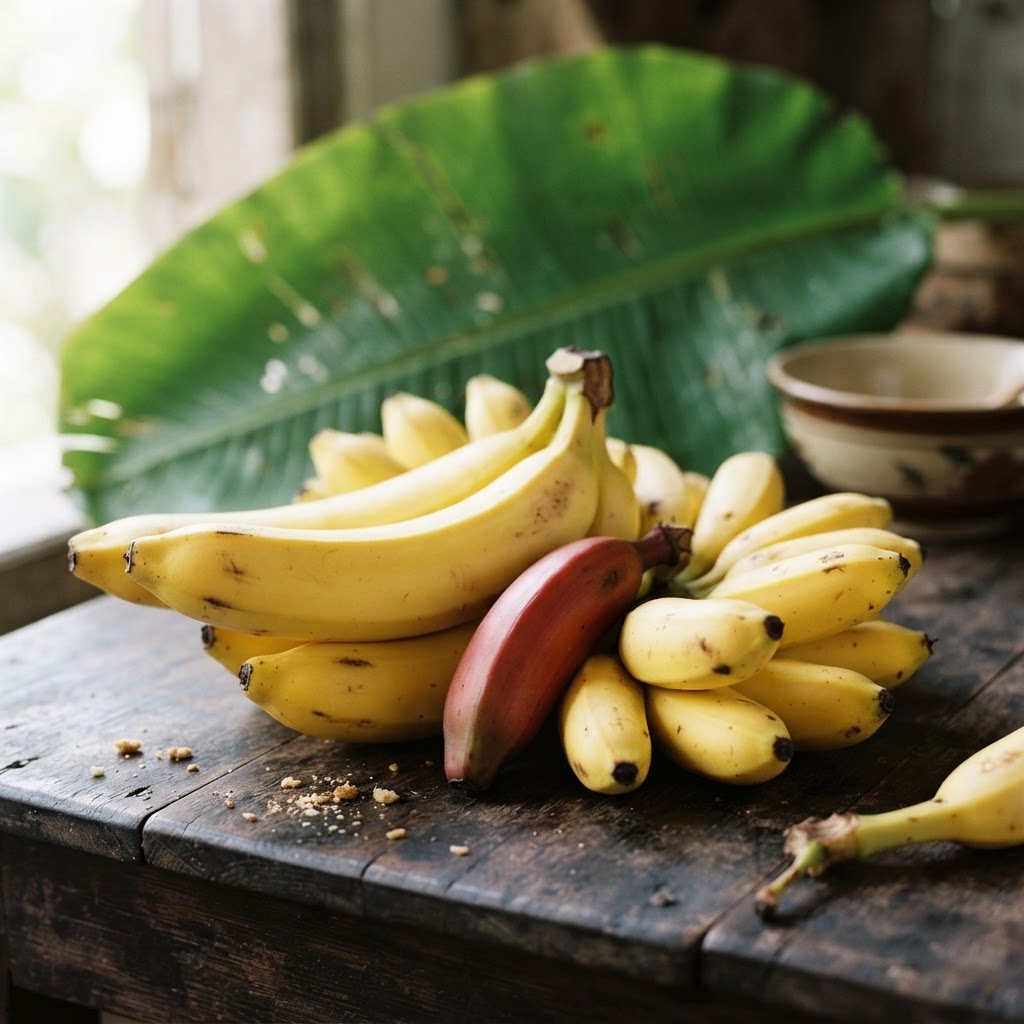
Australia grows a surprising range of bananas for a country with such a small tropical belt, and most of them never make it to a supermarket shelf outside their own region. Walk through a market in Far North Queensland and you will find half a dozen varieties that look and taste nothing like the Cavendish in the fruit bowl.
Sorting them out is mostly about the fruit — its length, its curve, how angular it is, and what colour the skin turns when it is ready.
Start With the Plant
If the question is what is growing in the garden, the plant itself is unmistakable. A banana is not a tree. It is a giant herbaceous plant, and the "trunk" is a pseudostem — a cylinder of tightly packed leaf sheaths wrapped around each other, with no wood in it at all. Push a knife into one and it slices through like celery.
The leaves are enormous, typically two to three metres long, paddle-shaped, with a thick central midrib and hundreds of parallel veins running out to the edge. Those veins are the reason banana leaves shred in wind: they tear along the lines between veins, which lets air through instead of toppling the plant.
New leaves emerge from the centre of the pseudostem rolled into a tight spike known as a cigar leaf. When the plant is mature enough to flower, the inflorescence pushes up through the same channel and then bends over to hang downward, with the female flowers nearest the top and the male bud — the large purple "banana heart" — at the bottom. That hanging bunch is the clearest confirmation you have a banana and not something that merely looks like one.
The Varieties You Will Actually Find
- Cavendish — the commercial standard and about 95% of world banana trade. Fruit is 15 to 25cm long, distinctly curved, with a smooth yellow skin at ripeness and a mild, sweet flavour. Grown in Far North Queensland.
- Lady Finger — short and plump, 10 to 13cm, with a noticeably angular, almost square cross-section and a thin skin. Sweeter and more aromatic than Cavendish, and prone to bruising. Popular in New South Wales and Queensland.
- Ducasse (sugar banana) — short, fat and very sweet, with a soft texture. Eaten raw when ripe but traditionally used for cooking in Queensland. Often sold at roadside stalls rather than supermarkets.
- Red Dacca — maroon to reddish-purple skin that turns orange-red when ripe, with creamy flesh that carries a faint raspberry note. Sweet and soft.
- Blue Java — blue-green skin that fades to pale yellow as it ripens, with flesh described as tasting of vanilla custard. Grown as much for novelty as for eating.
- Plantain — larger, straighter and firmer than a dessert banana, with high starch and low sugar. It must be cooked, and it is treated as a vegetable in most of the world rather than a fruit.
Comparing the Fruit
| Variety | Length | Ripe skin | Shape | Eaten |
|---|---|---|---|---|
| Cavendish | 15–25cm | Yellow | Long, curved, smooth | Raw |
| Lady Finger | 10–13cm | Thin yellow | Short, plump, angular | Raw |
| Ducasse | 10–14cm | Dull yellow | Short, fat | Raw or cooked |
| Red Dacca | 12–18cm | Orange-red | Medium, curved | Raw |
| Blue Java | 15–20cm | Pale yellow | Medium, thick | Raw |
| Plantain | 20–30cm | Yellow to black | Long, straight, ridged | Cooked only |
The plantain distinction is the one worth holding onto. Bananas and plantains are the same genus and closely related — the difference is starch versus sugar. A plantain eaten raw is dry, chalky and unpleasant. Cooked, it is one of the most versatile starches in the world.
Ripeness and Handling
Bananas are climacteric, which means they continue ripening after harvest and are driven by ethylene gas. Commercial fruit is picked green and ripened in controlled rooms, which is why supermarket bananas look identical year-round and taste nothing like a tree-ripened one.
Ripeness in a Cavendish is easy — yellow with a few brown speckles is peak sweetness. Lady Finger is trickier, because the thin skin bruises and blackens before the fruit is ready, so colour is a less reliable guide than feel. Our guide to ripening bananas faster covers the paper bag method for fruit that is too green, and why bananas brown faster than other fruit explains the enzyme chemistry behind the speed.
Bananas are grown year-round in Australia and do not have a season, as our guide to whether bananas are in season sets out. Supply is driven instead by cyclone risk in the tropical north.
The Number on the Sticker
If you want to know what you are buying at a glance, the sticker is worth reading. The number is a Price Look-Up code, and 4011 is the standard yellow Cavendish. A leading 9 means organic. Our guide to banana PLU codes decodes the rest.
Things That Look Like Bananas But Are Not
Two plants get mistaken for bananas regularly, and both are worth knowing.
Heliconia species — sometimes called false bird of paradise — have large paddle-shaped leaves that look very similar at a glance. The difference is in the leaf: heliconia leaves have a distinct central midrib with a pale, waxy channel along it, and the leaf stalks are much shorter, so the leaves cluster tightly. More decisively, heliconia flowers are upright, stiff and brightly coloured rather than hanging in a banana bunch.
Ensete, the Ethiopian banana, looks like a banana plant but produces no edible fruit at all. It is grown as an ornamental and as a starchy food crop in Ethiopia, where the pseudostem and corm are fermented rather than the fruit eaten.
If you are identifying fruit you have bought rather than plants in a garden, our tropical fruit scanner guide covers the wider range of fruit you are likely to meet in a tropical market.
The Short Version
Long and curved with smooth yellow skin means Cavendish. Short, plump and angular with thin skin means Lady Finger. Maroon skin means Red Dacca. Blue-green skin fading to yellow means Blue Java. Larger, straighter and ridged means plantain, and plantain must be cooked. And if the plant has a pseudostem you can slice like celery with a hanging bunch of fruit, it is a banana — not a heliconia, whose flowers stand upright and stiff.
Frequently Asked Questions
A banana plant has a pseudostem — a trunk made of tightly packed leaf sheaths with no wood, which slices easily. Leaves are 2–3m long with parallel veins that shred in wind. A mature plant sends up a hanging bunch with a large purple male bud at the bottom.