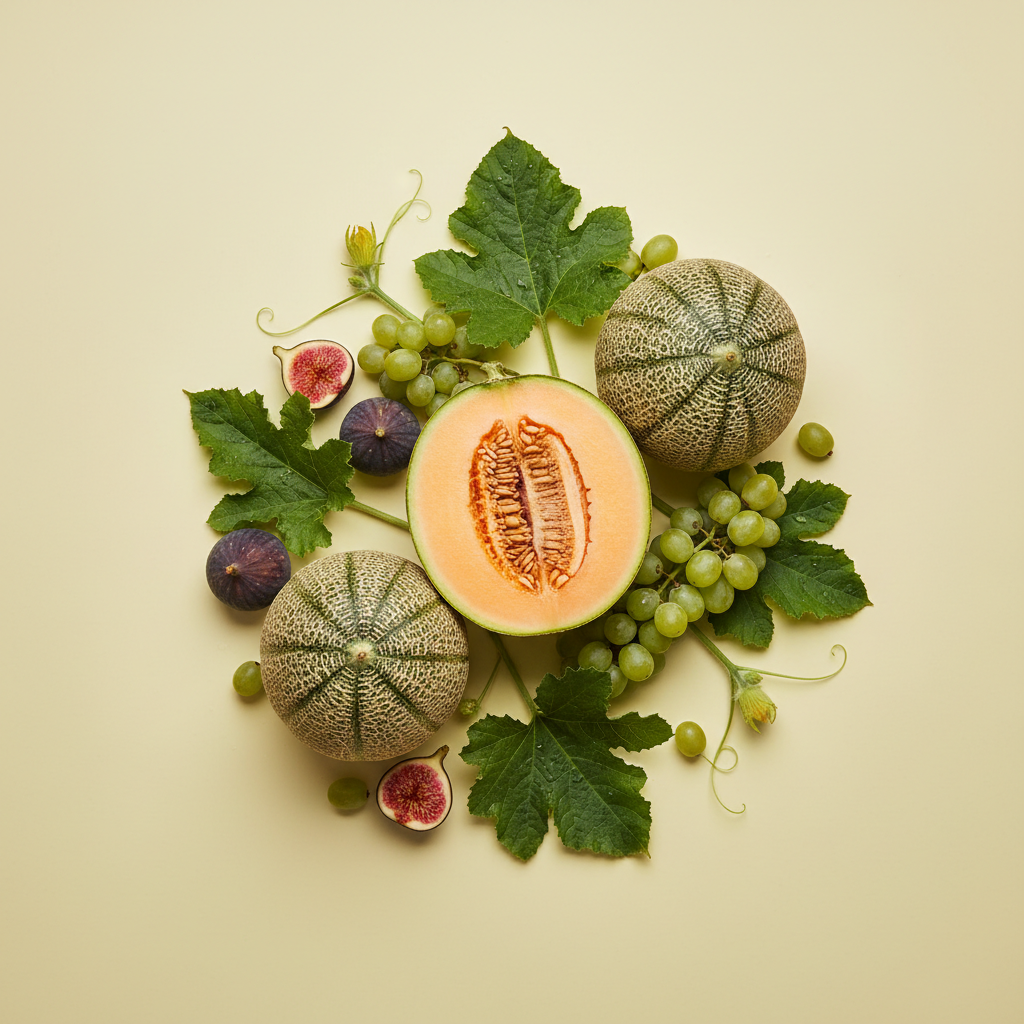
What Fruit Is In Season Now?
We set your region and month automatically from your device. Change either one to check any location or any month.
- AppleFuji, Pink Lady, Braeburn
- PearBosc, Comice at their best
- Grape (late)Very sweet, all varieties
- Fig (late)Very soft and sweet
- PersimmonSoft = sweetest
- Pumpkin (early)For cooking
- Pomegranate (early)Juice-filled seeds
- QuinceFragrant
- Stone FruitQuality very poor
📅 Coming Into Season
When Are Rockmelons in Season in your region?
Rockmelons in your region: peak season runs July and August. Timing shifts with local climate and supply, so treat this as a guide — the seasonal tool below breaks it down month by month.
How to Pick a Ripe Rockmelon
- The "belly button" smell: Smell the round end (opposite the stem). A strong, sweet, musky fragrance = ripe. No smell = underripe. Off smell = overripe.
- Slip test at stem end: The stem should look dry and slightly recessed. A clean, circular scar means it naturally separated from the vine (ripe). A jagged stem means it was cut early.
- Cream or yellow netting: The netting pattern on the skin should be raised and cream-coloured. Pale green netting = underripe.
- Slight give at belly end: The round end should give very slightly to firm pressure. Rock hard = underripe.
Rockmelon Nutrition
One cup of rockmelon (160g): 54 calories, 13g carbs, 1.4g fibre, vitamin A (120% DV), vitamin C (65% DV), potassium and folate. Rockmelon is one of the best fruit sources of vitamin A — the deep orange colour indicates high beta-carotene, which is essential for eye health and immune function.
Try These Rockmelon Recipes
Where Do Australian Rockmelons Grow?
Australian rockmelons are grown across several states, each producing at different times:
| Region | Season | Notes |
|---|---|---|
| Queensland (Bowen, Bundaberg, Chinchilla) | Sep–Mar | The largest rockmelon-growing state. Bowen produces early-season fruit from September. |
| Northern Territory (Katherine, Darwin) | May–Oct | Produces winter rockmelons when southern states cannot — ensures year-round supply. |
| New South Wales (Riverina, Griffith) | Dec–Mar | Summer production from irrigation districts. Known for large, sweet fruit. |
| Western Australia (Carnarvon, Kununurra) | Jun–Nov | Winter and spring supply from tropical northern WA. |
| Victoria & SA (Riverland, Sunraysia) | Jan–Mar | Late summer production from Murray River irrigation areas. |
This multi-state production means rockmelons are technically available year-round in Australia, but the sweetest, most flavourful fruit comes from Queensland during the December–February peak.
How to Store Rockmelon
Whole rockmelon
Whole, uncut rockmelons can be stored at room temperature for 2–3 days if not fully ripe. Once ripe (fragrant stem end, slight give), refrigerate and use within 5 days. Rockmelons do not get sweeter after harvest — they only soften.
Cut rockmelon
Once cut, rockmelon must be refrigerated in an airtight container and eaten within 2–3 days. Cut melon left at room temperature for more than 2 hours should be discarded — rockmelon has been linked to foodborne illness (including listeria and salmonella outbreaks) when improperly stored.
Food safety
Rockmelon's rough, netted skin can harbour bacteria. Always wash the outside of a whole rockmelon under running water before cutting — the knife can transfer bacteria from the skin to the flesh. This is particularly important for vulnerable groups including pregnant women, elderly people and those with compromised immune systems.
Rockmelon vs Cantaloupe vs Honeydew
- Rockmelon (cantaloupe): Orange flesh, netted skin, sweet musky flavour. The most common melon in Australia.
- Cantaloupe (true cantaloupe): In Europe, "cantaloupe" refers to a specific variety with smooth or lightly scaly skin. In Australia and the US, "cantaloupe" and "rockmelon" are used interchangeably.
- Honeydew: Green or white flesh, smooth pale skin, milder and less sweet than rockmelon. Different season and different flavour profile.
Rockmelon Health Benefits (Expanded)
- Vitamin A: One cup provides 120% of your daily vitamin A — the deep orange flesh signals high beta-carotene. Essential for eye health, immune function and skin.
- Vitamin C: 65% of your daily vitamin C per cup — supports immune function and collagen production.
- Potassium: Helps regulate blood pressure and supports muscle function.
- Choline: Important for brain development, memory and muscle movement.
- Low calorie: Just 54 calories per cup — one of the most nutrient-dense fruits per calorie.
Related Seasonal Guides
Frequently Asked Questions
Rockmelons are in season in Australia from October to March, peaking from December to February. Queensland produces the bulk of the crop. The Northern Territory and Western Australia produce winter rockmelons from May to November, ensuring year-round availability.