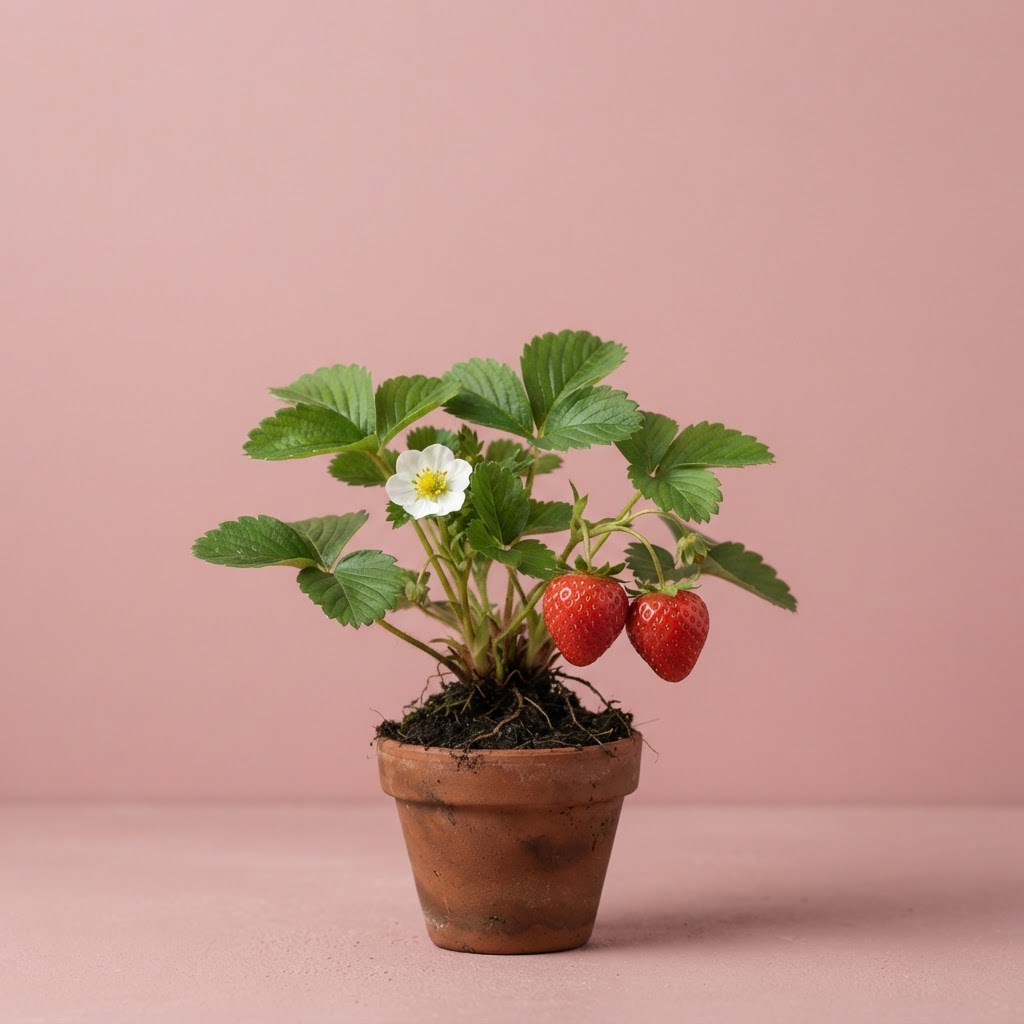
Strawberry plants are distinctive once you have seen one properly, but two situations cause real confusion. The first is early spring, when a strawberry plant is a low rosette of green leaves and looks like several common weeds. The second is when a plant produces no fruit and the grower starts wondering whether they planted the right thing at all.
Both are solvable with the same few features.
The Leaves: Three Leaflets, Always
Strawberry leaves are compound, and each leaf is made up of three leaflets. That trifoliate pattern is consistent across every strawberry variety and it is the first thing to check. Each leaflet is roughly oval, 3 to 8cm long, with a distinctly toothed edge running all the way around.
- Number: three leaflets per leaf, no more, no less
- Edges: toothed all the way round, including near the base
- Surface: medium green and slightly glossy on top
- Underside: noticeably paler, often with a silvery sheen and fine hairs
- Arrangement: all leaves rise from a central crown at ground level
That silvery underside is a good confirmation and it is easy to check by simply lifting a leaf. The toothed edge running right down to the base of each leaflet also rules out several weeds that have smooth-edged lower sections.
Growth Habit: The Crown and the Runners
Strawberry plants grow from a central crown sitting at or just above soil level. All leaves emerge from that crown, which is why the plant has a distinctly clumped, rosette-like appearance rather than spreading stems.
The other defining habit is runners. Strawberries send out long, thin, leafless stems that arch away from the parent plant and root at their tips, forming a new plant. These runners are the main way strawberries spread, and they are unmistakable once you see them — a single plant can produce half a dozen in a season.
If you are growing strawberries, runners are both a gift and a nuisance. They give you free plants, but they also drain energy from fruit production. Removing most runners during the fruiting season gives you a bigger crop, and letting a few develop at the end of the season gives you next year's plants. Our guide to growing strawberries in winter covers how to handle them through the cold months.
The Flowers
Strawberry flowers are simple and easy to recognise. Each has five white petals surrounding a yellow centre made up of many small stamens and pistils. They are usually 1.5 to 2cm across and held above the leaves on short stems.
The yellow centre is where the fruit will develop, and it is worth looking at closely. A flower with a large, healthy yellow centre is likely to set a good berry. A flower with a small or blackened centre usually will not. If your plants flower heavily but set very little fruit, poor pollination is the usual cause — strawberries are largely pollinated by bees and wind, and a cold or wet flowering period reduces bee activity considerably.
The Fruit
Strawberry fruit is the giveaway for most people, but the structure is worth understanding because it explains a lot. The red flesh is not the fruit at all — it is swollen stem tissue. The actual fruits are the tiny yellow-green seeds, or achenes, embedded on the surface.
That is why a strawberry is not botanically a berry. Botanists classify it as an aggregate accessory fruit, which is a mouthful that simply means the fleshy part comes from the flower base rather than the ovary.
What Gets Confused With Strawberry Plants
| Plant | How to tell it apart |
|---|---|
| Mock strawberry | Similar trifoliate leaves but yellow flowers, not white. Fruit is small, round, red and completely tasteless. |
| Barren strawberry | Yellow flowers again, and it does not produce edible fruit at all. Common as a ground cover. |
| Creeping cinquefoil | Yellow five-petalled flowers and trifoliate leaves. Very common lawn weed. |
| Wild strawberry | White flowers like cultivated strawberry but much smaller fruit with an intense flavour. Genuinely edible. |
| Buttercup | Yellow flowers and lobed, not toothed, leaves. Different leaf structure entirely. |
| Clover | Trifoliate but with smooth oval leaflets and no teeth at all. |
The single most useful test is flower colour. White flowers mean strawberry or wild strawberry. Yellow flowers mean mock strawberry, barren strawberry or cinquefoil — none of which are poisonous, but none of which will give you a crop either. This is the most common reason someone's "strawberry patch" never produces anything worth eating.
Leaves You Can Actually Eat
One thing many growers do not realise is that strawberry leaves are edible. They are mildly astringent and are commonly used in herbal teas. They are safe to eat raw in small quantities and are a traditional addition to salads, though the flavour is subtle. Our guide to eating strawberry leaves covers the details, and this piece looks at what is actually in them nutritionally.
Pick young leaves from healthy plants, and avoid taking too many from a plant you want to keep fruiting — the leaves are the plant's solar panels and removing them costs you fruit.
Growing Notes
Strawberries want full sun, well-drained soil and consistent moisture. They are heavy feeders during the fruiting season and benefit from straw or pine needle mulch, which keeps fruit off the soil and reduces rot. Planting them slightly high on a mound helps with drainage, since crown rot is the most common way home strawberry plants die.
Replace plants every two to three years. Yields drop sharply after the second season, and older plants are more prone to disease. Runners taken from healthy plants are the cheapest way to refresh a bed. Once you have fruit, our serving size guide and nutrition breakdown cover what you are actually eating.
The Short Version
Strawberry plants have trifoliate leaves with toothed edges and silvery undersides, white five-petalled flowers with a yellow centre, and long thin runners that root at the tips. If the flowers are yellow, you have mock strawberry, barren strawberry or cinquefoil — and no amount of waiting will produce a crop.
Frequently Asked Questions
Look for leaves made of three leaflets, each with a toothed edge and a paler, silvery underside. The flowers are white with five petals and a yellow centre, and the plant spreads by long thin runners that root at the tips.