Flowers are one of the most useful identification features in a nut tree, partly because they are conspicuous and partly because their timing is so consistent. A tree in full flower in late winter with no leaves is almost certainly a hazel. A mass of pale pink blossom on bare branches in early spring is almost certainly an almond.
Understanding why nut trees flower the way they do also explains a lot about how they are pollinated, and why some crop reliably and others do not.
The Two Flowering Strategies
Nut trees fall into two groups, and the split explains almost everything about their flowers.
Wind-pollinated trees produce catkins — long, dangling clusters of tiny flowers with no petals, because they do not need to attract insects. Walnuts, pecans, hickories, hazels and chestnuts all use this strategy. Their flowers are easy to overlook, but they are produced in enormous numbers.
Insect-pollinated trees produce conventional flowers with petals, scent and nectar. Almonds and macadamias are the main nut trees in this group, and both are heavily dependent on bees. That dependence is why almond orchards are trucked in with hives every spring.
Hazel: Late Winter Catkins
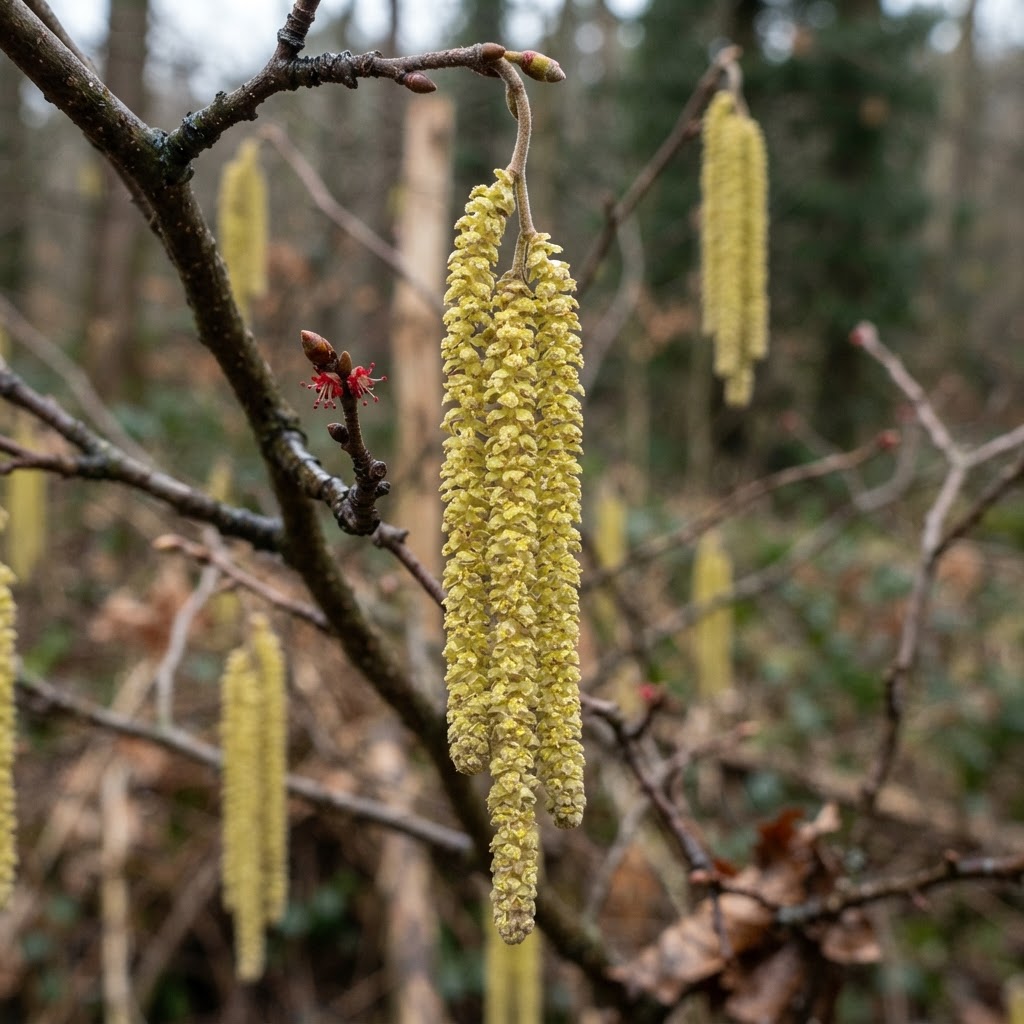
Hazel (Corylus) is the earliest of the nut trees to flower, and the most noticeable. In late winter, before any leaves appear, the male catkins elongate into dangling yellow-green cylinders — the "lambs' tails" that are one of the classic signs that spring is coming.
The female flowers are tiny and easily missed: a small red tuft at the tip of a bud, with no petals at all. If you look closely at a hazel in late winter you can usually find both on the same bush.
Because hazels flower so early, they rely entirely on wind for pollination, which is why they produce catkins in such quantity. See hazel tree leaf identification for the leaves that follow.
Almond: Early Spring Blossom
Almond blossom is the showiest of any nut tree and appears before almost any other fruit tree. The flowers are pale pink fading to white, 3 to 5 centimetres across, with five rounded petals and a prominent cluster of stamens.
They open in late winter to early spring, usually before the leaves emerge, covering the bare branches in a mass of colour. Almonds are insect-pollinated and highly dependent on bees, which is why commercial orchards place hives at flowering time.
See almond tree identification for the leaves and fruit.
Walnut, Pecan and Hickory: Late Spring Catkins
Walnuts, pecans and hickories all flower in late spring, after or as the leaves are emerging. Their male catkins are long, green and drooping, hanging in clusters from the previous year's wood. They are easy to miss against the new foliage, which is why most people never notice them.
All three are wind-pollinated and monoecious — male and female flowers on the same tree, but maturing at different times. That staggered timing reduces self-pollination, which is why pecans in particular often crop better with a second variety nearby.
If you see long green catkins hanging from a large tree in late spring and the leaves are pinnately compound, you are looking at one of these three. See pecan identification and black walnut identification for the details.
Chestnut: Midsummer Spikes
Chestnut flowers appear in midsummer and are quite distinctive. Sweet chestnut produces long, upright, pale yellow catkins — creamy spikes that stand out from the foliage and have a somewhat unpleasant, slightly sour scent.
The catkins carry both male and female flowers, with the female flowers near the base. Once pollinated, the female flowers develop into the spiny burrs that will hold the nuts.
Horse chestnut flowers at roughly the same time but looks completely different: upright conical clusters of white flowers with a yellow or pink blotch, often called "candles". If you see candles, the tree is a horse chestnut and the nuts are not edible. See chestnut tree identification.
Macadamia: Creamy Racemes
Macadamia is the other insect-pollinated nut tree, and it is native to Australia. The flowers grow in long, drooping racemes — slender spikes carrying many small creamy white to pale pink flowers.
A macadamia in full flower is a striking sight, and the scent is sweet and noticeable. Flowering typically happens in late winter to spring, depending on the species and climate. See macadamia tree identification.
Flowering Calendar
| Tree | Flowering time | Flower type |
|---|---|---|
| Hazel | Late winter | Yellow catkins, tiny red female flowers |
| Almond | Late winter to early spring | Pale pink to white blossom |
| Macadamia | Late winter to spring | Creamy white racemes |
| Walnut | Late spring | Green drooping catkins |
| Pecan, hickory | Late spring | Green drooping catkins |
| Sweet chestnut | Midsummer | Long pale yellow upright catkins |
| Horse chestnut | Late spring | White upright candles — not edible |
The Short Version
Most nut trees are wind-pollinated and flower with catkins: hazel in late winter, walnuts and pecans in late spring, chestnuts in midsummer. Almond and macadamia are insect-pollinated with showy blossom, flowering in late winter to spring. Horse chestnut flowers are white upright candles and signal a tree whose nuts are not edible.
Frequently Asked Questions
Hazel. Its yellow catkins appear in late winter, often before any other tree has shown signs of activity, followed closely by almond blossom.