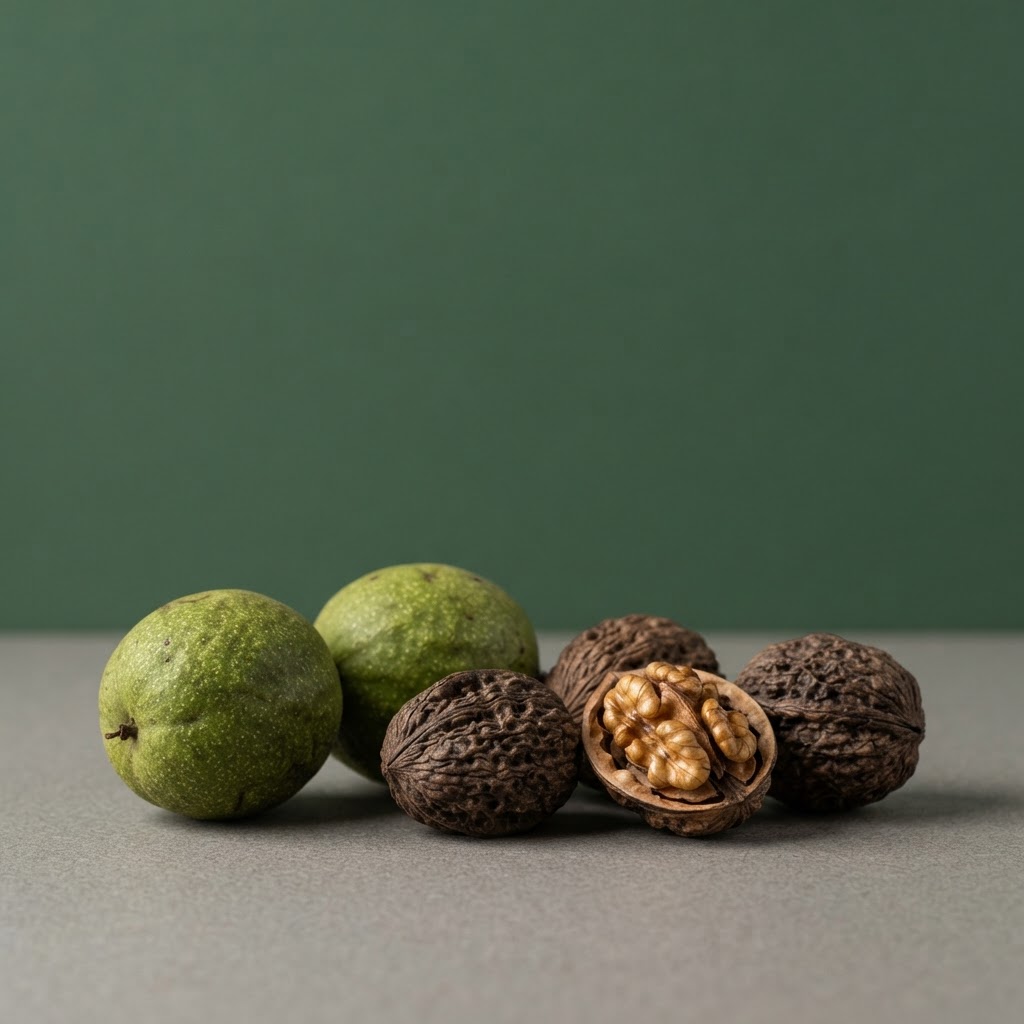
Black walnut is one of the most distinctive trees in eastern North America, and one of the most troublesome to live with. It produces excellent nuts that are genuinely difficult to extract, a husk that stains skin and concrete a persistent yellow-brown, and a chemical that quietly kills many of the plants you might want to grow near it.
Learning to identify it is worthwhile both for foraging and for gardening, because a black walnut changes what you can plant within a wide radius.
The Tree at a Glance
Black walnut is a large deciduous tree, commonly reaching 20 to 30 metres in good conditions, with a straight trunk and a relatively open, rounded crown. It is native to eastern and central North America and is grown elsewhere as a timber and nut tree.
The wood is dark, hard and highly prized for furniture, which is why the species has been widely planted outside its native range.
Leaves
Black walnut leaves are pinnately compound — that is, multiple leaflets arranged along a central stem, with a leaflet at the tip. This is the first feature to check.
- Leaflet count. Typically 15 to 23 leaflets per leaf, which is more than most other walnuts.
- Leaflet shape. Narrow, pointed and finely serrated along the edges.
- Terminal leaflet. Often small, reduced, or missing entirely — a useful distinguishing feature.
- Surface. Smooth and slightly glossy above, paler and lightly hairy beneath.
- Scent. Crushed leaves have a distinct spicy, citrus-adjacent aroma.
Our guide to identifying nut trees by leafcompares these features across walnuts, hickories and pecans.
Bark
Black walnut bark is dark grey-brown to nearly black and deeply furrowed, forming a rough network of ridges. On mature trees the ridges frequently intersect to create diamond or X-shaped patterns, which is one of the most recognisable features of the species.
Young trees have smoother, lighter grey bark that becomes progressively rougher with age. The furrowing is usually well established by the time a tree is twenty years old.
The Nuts and Husks
Black walnut fruit is a round, green, fleshy husk that ripens in autumn, turning yellow and then black-brown as it breaks down. The husk does not split open on the tree the way a pecan husk does — it softens and rots away, or is removed by hand.
The husk is the source of the staining. It is rich in juglone and tannins, and handling it will mark your hands a persistent yellow-brown that takes days to fade. Wear gloves.
Inside the husk is the shell, which is the key identifying feature. A black walnut shell is:
- Roughly round to slightly oval
- Extremely thick and hard
- Deeply ridged and pitted across the whole surface
- Very difficult to crack without a vice or hammer
Compare that with an English or Persian walnut, which has a thin, lightly textured shell that cracks easily by hand. See identifying nut shells for a fuller comparison.
The Kernel
Black walnut kernels are deeply wrinkled and divided into four distinct lobes, with a rich, strong, slightly astringent flavour that many people prefer to the milder English walnut. The kernel is smaller relative to the shell than in commercial walnuts, which is part of why black walnuts are not grown commercially at scale.
The flavour is intense enough that black walnuts are usually used in baking and ice cream rather than eaten by the handful.
Juglone: The Garden Problem
This is the feature that surprises people most. Black walnut produces juglone, a compound that is toxic to a wide range of plants. It is present in the leaves, bark, husks, roots and nut shells, and it accumulates in the soil beneath and around the tree.
Plants known to be sensitive to juglone include tomatoes, potatoes, peppers, eggplant, and many ornamental shrubs. Symptoms appear as wilting and yellowing that looks like drought stress but does not respond to watering.
Plants that tolerate juglone reasonably well include most grasses, beans, squash, melons, carrots and onions. The affected zone typically extends well beyond the canopy, because walnut roots spread widely.
The practical implication is simple: if you have a black walnut, plan your vegetable garden well away from it, and do not compost the husks or leaves into beds where sensitive crops will grow.
Black Walnut vs Other Walnuts
| Feature | Black walnut | English walnut |
|---|---|---|
| Leaflets per leaf | 15–23 | 5–9 |
| Shell | Thick, deeply ridged, very hard | Thin, lightly textured, easy to crack |
| Kernel flavour | Strong, astringent | Mild, sweet |
| Bark | Dark, deeply furrowed, diamond ridges | Lighter grey, smoother |
| Juglone | High | Lower but still present |
The Short Version
Black walnut has 15 to 23 serrated leaflets, dark bark furrowed into diamond patterns, a green husk that stains badly, and a thick, deeply ridged shell that is very hard to crack. It also produces juglone, which is toxic to tomatoes, potatoes and many ornamentals — so keep sensitive plants well clear.
Frequently Asked Questions
Look for pinnately compound leaves with 15 to 23 finely serrated leaflets, dark deeply furrowed bark forming diamond patterns on mature trees, and round green husks that stain your hands yellow-brown.