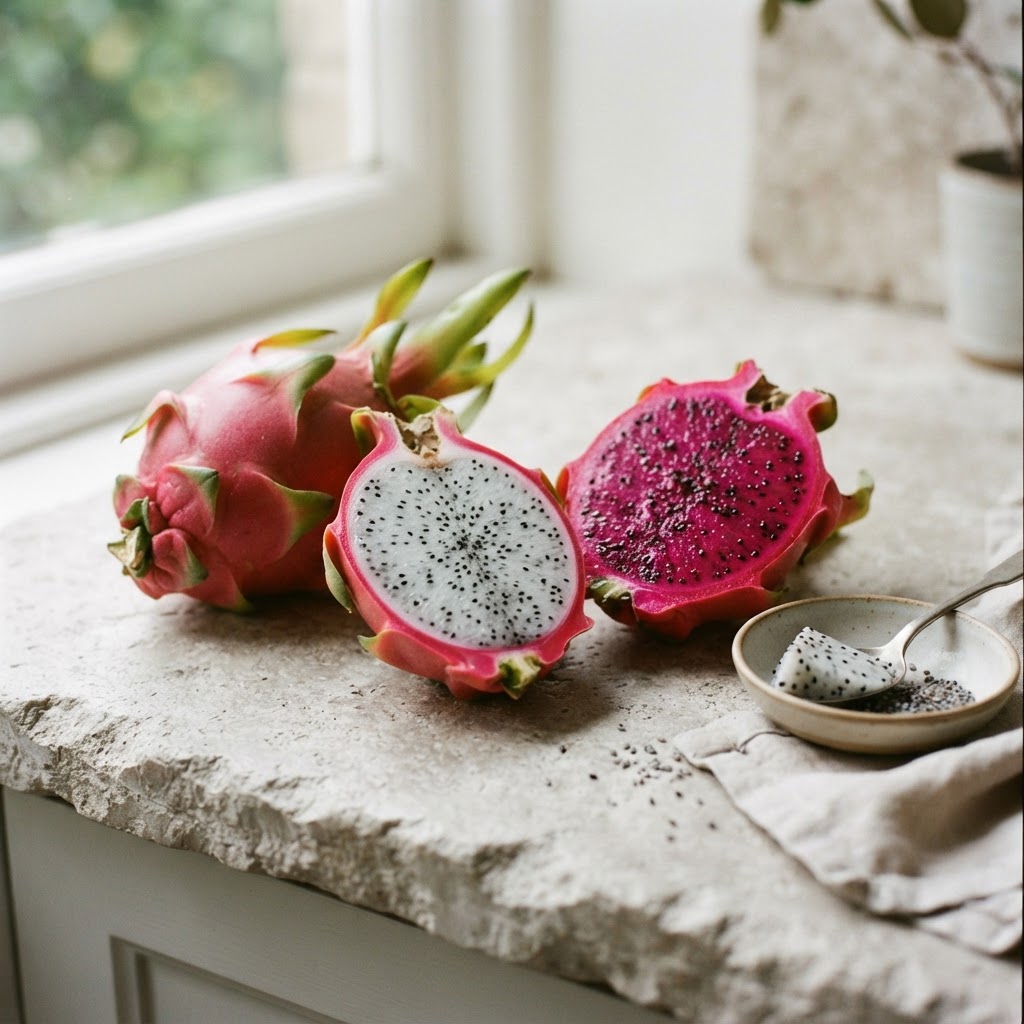
Dragon fruit looks like something designed rather than grown. That is largely down to the scales — leaf-like green flaps running down the sides of the fruit, which are the single feature that makes a dragon fruit impossible to confuse with anything else.
Working out which variety you have is then a matter of cutting it open. The skin tells you part of the story, but the flesh settles it.
The Three You Will Find
Commercially, dragon fruit comes in three broad groups, and each one has a different flavour profile. They are all climbing cacti in the genus Selenicereus, which was formerly split into Hylocereus for the climbing species.
- White-fleshed (Selenicereus undatus) — pink to magenta skin with prominent green-tipped scales, and crisp white flesh. This is the variety you will find in almost every Australian supermarket. The flavour is mild and slightly sweet, closer to a melon than anything tropical.
- Red-fleshed (Selenicereus costaricensis and S. polyrhizus) — similar pink skin, but the flesh is deep magenta to red. Sweeter, more aromatic and noticeably more flavourful than the white variety. The juice stains badly, which is why it is rarely sold pre-cut.
- Yellow (Selenicereus megalanthus) — bright yellow skin with small knobbly bumps rather than long scales, and white flesh. This is the sweetest of the three by a clear margin, with a floral, almost honeyed flavour. It is also the one that is spiny on the plant.
Comparing Them
| Type | Skin | Flesh | Sweetness | Notes |
|---|---|---|---|---|
| White-fleshed | Pink, long green scales | White | Mild | The supermarket standard |
| Red-fleshed | Pink, long green scales | Deep magenta | Sweet | Stains everything; best flavour |
| Yellow | Yellow, small bumps | White | Sweetest | Spiny on the plant |
The scale shape is the useful field distinction. White and red-fleshed varieties both carry long, leaf-like scales running the length of the fruit. The yellow variety does not — it has short, rounded bumps instead, and a slightly smaller, more oval fruit.
The Plant
Dragon fruit is a climbing cactus, not a tree and not a shrub. The stems are thick, fleshy and three-angled — triangular in cross-section — typically 3 to 4cm wide, and green with a waxy surface. They scramble up trees, walls and trellises using aerial roots that cling to any rough surface.
Along the edges of the stems are areoles, the small nodes that on most cacti carry spines. On dragon fruit they carry one to three short, sharp spines. The spines are easy to overlook until you grab a stem without gloves.
The flowers are the most spectacular part of the plant and the easiest way to confirm what you have. They are enormous — 25 to 30cm long — white or cream with a ring of pale green sepals, and they open at night and close by morning. A single flower lasts one night. Pollination is by bats and moths in the plant's native range, and by hand in most commercial orchards, because many varieties are self-incompatible and need pollen from a different plant.
Telling When It Is Ripe
Dragon fruit is one of the easier tropical fruits to judge, because the scales do the work for you.
- Scales — on a ripe fruit the scales begin to dry and brown at the tips. A fruit with bright, uniformly green scales is underripe.
- Give — press gently with a thumb. A ripe dragon fruit yields slightly, like a ripe kiwi. A hard fruit is not ready.
- Colour — the skin deepens and brightens as it ripens. A dull, pale pink suggests it was picked early.
Unlike bananas or avocados, dragon fruit does not improve much after picking. A fruit harvested underripe will soften but will not gain sweetness, which is why the scales are worth checking before you buy.
Inside the Fruit
Cut a dragon fruit in half and you find flesh studded with thousands of tiny black seeds. They are entirely edible and give the fruit a texture somewhere between a kiwi and a pear.
That seed count puts dragon fruit high in the rankings of seedy fruit. Our piece on which fruit has the most seeds compares it with the pomegranate and the fig, and it turns out dragon fruit is nowhere near the record holder.
Botanically, the fruit is a berry — a large one, with a thick skin and many seeds — which is the same category that covers tomatoes, bananas and blueberries. If the classification surprises you, our guide to identifying berries explains what actually counts as one.
Red-fleshed varieties get their colour from betalains, the same pigments found in beetroot. They are not the same as the anthocyanins in berries, and they behave differently in cooking — the colour survives freezing but fades with prolonged heat.
Growing It in Australia
Dragon fruit grows well in the tropical and subtropical parts of Australia, and increasingly in warm temperate gardens with a sheltered spot. It needs three things: full sun, excellent drainage, and something to climb.
The usual approach is a sturdy post with a crossbar at the top, allowing the stems to climb and then drape over. The plant flowers and fruits on the drooping stems, not on the upright growth, so training it over a frame is not just tidiness — it is what produces fruit.
Most varieties need cross-pollination to set fruit reliably, which is why a single plant often flowers spectacularly and produces nothing. Planting a second, genetically different variety nearby solves it, as does hand-pollinating with a soft brush at night while the flowers are open.
If you are working through a market stall of unfamiliar tropical fruit, our guide to the tropical fruit scanner covers the wider range — rambutan, lychee, jackfruit, durian and the rest.
The Short Version
Pink skin with long green scales and white flesh is the standard white-fleshed dragon fruit. The same skin with magenta flesh is the red-fleshed variety, sweeter and heavily staining. Yellow skin with small bumps rather than long scales is the yellow variety, and the sweetest of the three. Ripe fruit has scales that are browning at the tips and gives slightly to a gentle press.
Frequently Asked Questions
Cut it open. Pink skin with long green scales and white flesh is the white-fleshed variety, the supermarket standard. The same skin with deep magenta flesh is red-fleshed, which is sweeter and stains badly. Yellow skin with small bumps instead of long scales is the yellow variety, the sweetest of the three.