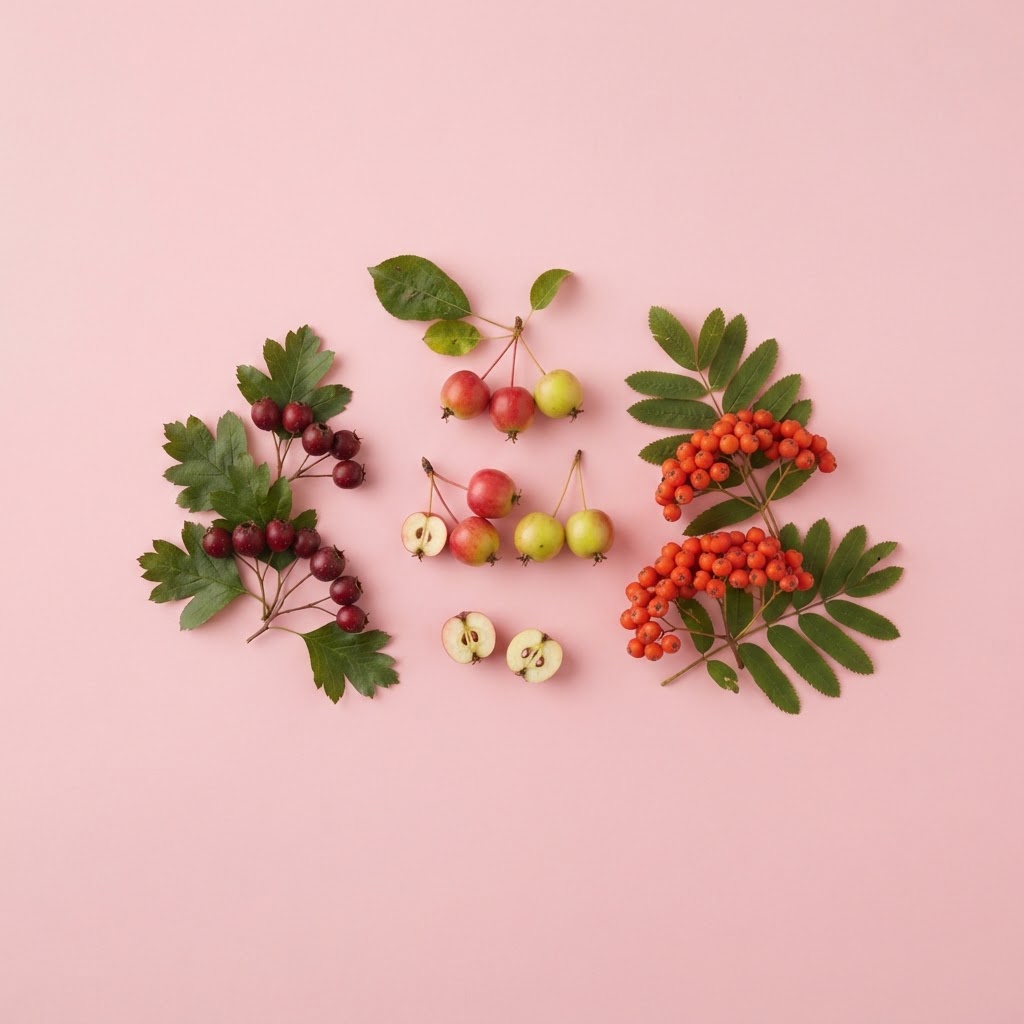
Crabapples are not one species. The name covers dozens of Malus species and hybrids grown for their flowers, their fruit, or both, and the fruit varies from pea-sized and bitter to almost indistinguishable from a small eating apple.
That variety is what makes crabapple identification both interesting and slightly maddening. The features that matter are consistent, but the range is wide.
What Makes a Crabapple a Crabapple
In practice, any Malus with fruit under about five centimetres is called a crabapple. Above that, it is an apple. The dividing line is a convention rather than a botanical fact.
The features to check are the same as for any apple, just smaller.
- Size. One to four centimetres across is typical. Some are barely a centimetre.
- The calyx. The dried five-pointed star at the base of the fruit, opposite the stalk. Every apple and crabapple has one. It is your strongest confirmation that you are in the right genus.
- Seeds. Cut it open. You should find several small dark seeds in a five-chambered core. Hawthorn has one stone instead.
- Stalk. Usually long and thin, often longer than the fruit itself.
- Skin. Can be yellow, orange, red, purple or green, often with a waxy bloom.
Cut It Open — That Is the Test
Almost every confusion in this group is resolved by cutting the fruit in half. It takes ten seconds and it is decisive.
| Fruit | Inside | Base |
|---|---|---|
| Crabapple | Several small seeds in a five-chambered core | Dried five-pointed calyx |
| Hawthorn | One single hard stone | Small dark dot at the tip |
| Rowan | Two or three tiny seeds | Small star, fruit grows in flat clusters |
| Cotoneaster | Two or three small stones | Tiny star, fruit grows tight to the stem |
Multiple seeds in a core means Malus. One stone means Crataegus, hawthorn. That single distinction settles most of the arguments.
Leaf Clues While You Are There
Crabapple leaves are oval to egg-shaped with a finely toothed edge, held alternately along the shoot, and often slightly fuzzy when young. They are ordinary-looking leaves, which is the point — nothing about a crabapple leaf shouts at you.
Rowan leaves are pinnate, made up of many small leaflets along a central stalk, and look almost fern-like. Hawthorn leaves are small and deeply lobed, often with two or three distinct lobes per side. Neither looks remotely like a crabapple leaf once you know what you are looking for.
Which Crabapples Are Worth Eating?
All true crabapples are edible in the sense that they are not poisonous, but "edible" and "worth eating" are different questions. Most are extremely tart, often astringent, and some are genuinely unpleasant raw.
The good news is that crabapples are outstanding for cooking. They are high in pectin, which means they set jelly reliably, and their tartness survives cooking in a way that sweeter apples do not. A crabapple jelly is one of the best things you can make from a garden tree.
Varieties bred for fruit rather than flowers are usually better eating. Some named crabapples are genuinely sweet enough to eat from the tree. The ones bred purely as ornamentals tend to have small, hard, bitter fruit that is only worth processing.
One safety note worth knowing. Apple and crabapple seeds contain amygdalin, which releases cyanide when the seed is crushed and digested. Swallowing whole seeds is harmless — they pass through intact — but you should not crush and eat seeds in quantity, and you should not blend whole crabapples into a smoothie. When making jelly, strain the juice; the seeds are removed with the pulp.
The Ornamental Crabapple Problem
Crabapples are planted in their millions for spring blossom, and most of those trees were selected for flower colour and disease resistance rather than fruit quality. The result is that a street full of beautiful crabapples in October produces fruit that is technically edible and practically inedible.
There is no way to tell from the fruit alone whether a crabapple was bred for eating or for looking at. The only reliable test is to taste one. If it is mouth-puckeringly sour with no sweetness underneath, it is a jelly crabapple. If it is tart but pleasant, you can eat it fresh.
If you are trying to name a specific variety rather than the species, the features that matter are the same ones that apply to apples — skin colour, size, flesh texture, flavour and ripening season. Our apple variety identifier guide works through the method, and the apple tree identification guide covers the tree itself.
What Crabapples Are Actually For
Jelly is the main answer. Chop the fruit, barely cover with water, simmer until soft, then strain through a cloth overnight without squeezing — squeezing makes the jelly cloudy. Measure the juice, add roughly three-quarters of its weight in sugar, and boil to setting point.
Beyond jelly, crabapples make excellent chutney, they can be roasted alongside pork, and they add a sharp note to apple pies and crumbles. They also make a good fruit vinegar and, if you are patient, a decent fruit wine.
If you are working out what else is on the tree or in the hedge beside it, the tree with orange berries identifier covers the small orange-fruited species, and identifying fruit trees by leaf will help with anything that has not fruited yet.
The Short Version
Cut it open. Several seeds in a five-chambered core with a dried five-pointed calyx at the base means crabapple. One stone means hawthorn. Tiny berries in flat clusters means rowan. Then decide whether to eat it by tasting it — and if it makes your face fold in, make jelly.
Frequently Asked Questions
A crabapple is any Malus with fruit under about five centimetres, with a dried five-pointed calyx at the base and several small seeds in a five-chambered core. Cut one open — if it has multiple seeds and a star-shaped calyx, it is a crabapple. Hawthorn has a single stone instead.