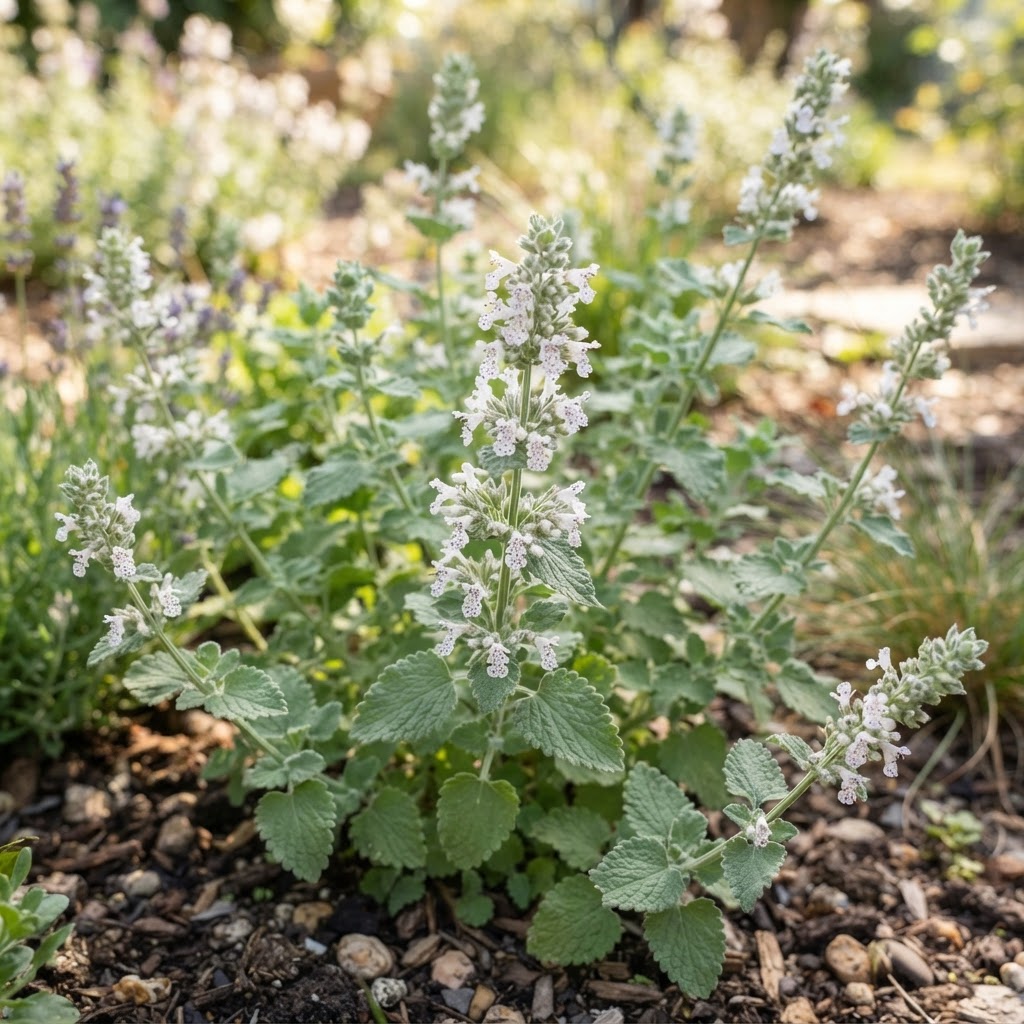
Catnip is grown for two reasons and identified badly for one of them. People plant it for cats, then wonder whether the thing spreading through the herb bed is catnip, catmint, lemon balm or plain garden mint. They are all related, all in the mint family, and all reasonably similar.
Telling them apart comes down to texture, flower colour and scent, in that order.
What Catnip Looks Like
Catnip — Nepeta cataria — is a herbaceous perennial that dies back in winter and returns from the base each spring. In a good spot it will reach 60–100cm and flop outward into a loose, sprawling clump.
- Stem. Square in cross-section and covered in fine white down. Pale green, sometimes with a purple tinge.
- Leaves. Opposite, roughly triangular to heart-shaped, with a pointed tip. Grey-green rather than bright green.
- Leaf edge. Distinctly scalloped — rounded teeth rather than sharp ones.
- Leaf texture. Soft and downy. Run a finger over it and it feels like felt. This is the most useful visual cue.
- Flowers. Small and white, heavily speckled with pale purple or pink dots, held in dense spikes at the top of the stems. They appear in summer and carry on for weeks.
- Scent. Crushed leaf smells minty with a clear lemon note and something faintly musty underneath.
Catnip vs Catmint
This is the confusion that catches almost everyone, because the names are used interchangeably in nurseries and the plants are close relatives.
| Feature | Catnip | Catmint |
|---|---|---|
| Scientific name | Nepeta cataria | Nepeta × faassenii and cultivars |
| Flower colour | White with purple speckles | Lavender-blue to violet |
| Leaf colour | Grey-green | Greyer, almost silver |
| Leaf size | Larger, 3–7cm | Smaller, 2–4cm |
| Habit | Tall, loose, floppy | Low, neat, mounding |
| Attractiveness to cats | High | Low to moderate |
| Seed | Sets viable seed freely | Usually sterile hybrid |
Catmint is the tidy one you see in landscape plantings and along path edges. It is a sterile hybrid, so it stays where you put it. Catnip is the untidy one that seeds itself everywhere — which is exactly why gardeners end up with it in the lawn.
Catnip vs Lemon Balm vs Mint
All three have square stems and opposite leaves, so the stem test alone will not separate them.
Lemon balm (Melissa officinalis). Brighter, yellower green than catnip, with larger leaves that are deeply veined and visibly crinkled. The scent is much more strongly lemon and lacks catnip's musty undertone. It also has a looser, more bushy habit and does not flop the way catnip does.
Spearmint and peppermint (Mentha species). Leaves are darker green, smoother, and more sharply toothed, with a clean, strong mint smell and no lemon. Mint also spreads by runners underground, which catnip does not. Flowers are usually pale lilac in rounded whorls, not white speckled spikes.
Horehound (Marrubium vulgare). Another grey, woolly mint-family plant, and the closest match to catnip's texture. Horehound leaves are more deeply wrinkled, more sharply toothed, and the flowers are small and white in dense whorls around the stem. The smell is bitter and medicinal rather than minty.
Why Cats React the Way They Do
Catnip contains a volatile compound called nepetalactone. When a cat inhales it, it binds to olfactory receptors in the nasal cavity and triggers a response through the same pathway involved in mating behaviour. What follows — rolling, rubbing, chin-dragging, purring, sometimes a burst of zooming around followed by a flop — typically lasts five to fifteen minutes, after which the cat loses interest for an hour or so.
Two things are worth knowing. First, the response is inherited: roughly half to two-thirds of adult cats react, and kittens under about three months usually do not. Second, it is not universal across the animal kingdom, though many cats in the wider family — lions, leopards and jaguars — do respond.
The response is not harmful and cats do not become addicted. If your cat ignores catnip entirely, that is a genetic trait, not a problem.
Growing and Using It
Catnip is undemanding. It wants sun and well-drained soil and will happily grow in poor ground. Too much richness produces soft, floppy growth with less scent. It is drought-tolerant once established and rarely troubled by pests, though cats themselves will flatten it repeatedly.
If you are growing it for cats, cut stems just as the flowers open and dry them in bunches. Dried catnip keeps its potency for months in an airtight jar. Fresh leaves work too, but they lose their effect within a day of picking.
If you are growing it for the kitchen, use the young leaves before flowering. Catnip makes a pleasant tea and works in the same way lemon balm does. It is a mild herb, so use it fresh rather than dried where you can.
One practical warning: catnip self-seeds aggressively. Deadhead it if you do not want it appearing in the lawn, the path and the neighbour's garden. Our herb identifier guide covers the other mint-family herbs it gets confused with, and if you are working out what has volunteered in your beds, the weed identifier guide is the place to start.
Frequently Asked Questions
Look for soft, downy grey-green leaves with scalloped edges growing in opposite pairs on a square stem. The flowers are small, white and speckled with purple, held in spikes at the top of the plant. Crushed leaves smell minty with a lemon note.