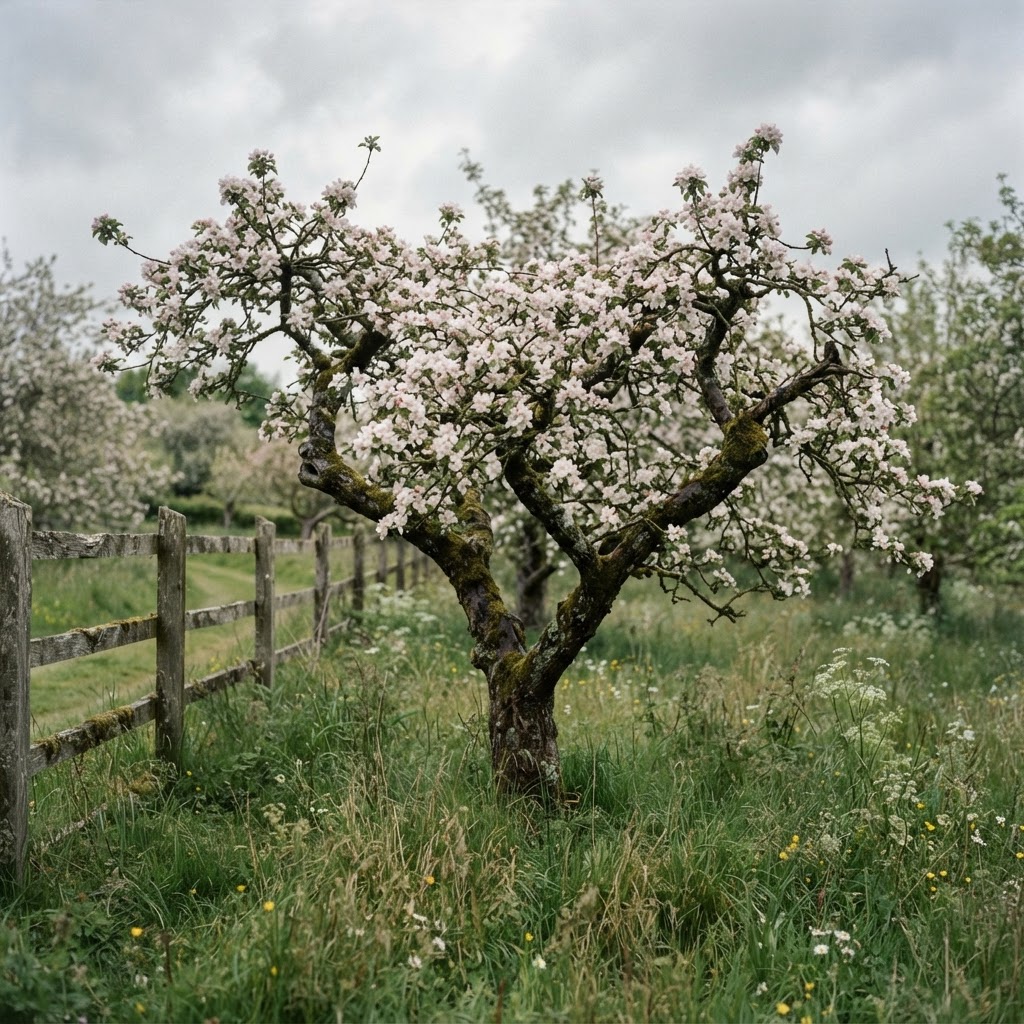
Britain has an unusually rich history of fruit growing for its size. Centuries of orchards, hedgerows and kitchen gardens left behind a landscape full of apple, pear, plum, cherry, damson, quince and medlar trees — many of them now standing in gardens where nobody remembers what was planted.
The trick with identifying them is not to try to name the variety. Variety identification is genuinely difficult and often needs the fruit in hand. Identifying the type of tree, though, is very achievable, and it can be done at almost any time of year if you know which features to use in which season.
The Seasonal Method
Each season gives you a different set of evidence, and they are not equally reliable. Blossom is decisive but brief. Leaves are available for seven months. Bark is available always but needs experience. Fruit settles everything.
- Early spring (March–April): blossom before or with the leaves — plum, damson, cherry, blackthorn
- Late spring (late April–May): blossom after the leaves have opened — apple, pear, quince, medlar
- Summer: leaf shape, leaf arrangement, and the presence of leaf glands
- Autumn: fruit structure, which is the single most reliable feature
- Winter: bark pattern, bud shape and the arrangement of buds on the twig
Blossom Timing
The most useful thing to learn first is the order in which the common trees flower. It splits the group cleanly in two.
Blackthorn (Prunus spinosa) is first, flowering in March and early April on bare black twigs, before any leaves appear. The white flowers are dense along the branches and the tree looks frosted. This is the ancestor of the damson and it produces sloes — small, round, blue-black fruit so astringent they need a frost or a bottle of gin before they are pleasant.
Cherry follows, flowering in April and early May. Wild cherry (Prunus avium) is a large tree with white flowers in loose clusters, while sour cherry (Prunus cerasus) is smaller with darker, more acidic fruit.
Plum and damson overlap with cherry, flowering in April. The flowers are white to greenish-white and the emerging leaves give them away.
Then apple, pear, quince and medlar flower in late April and May, once the leaves are properly out. Apple blossom is pink in bud and fades to white, held in clusters of five or six. Pear blossom is white and opens slightly earlier than apple, with flowers in looser trusses. Quince flowers are large, single and pale pink — much showier than you would expect from the fruit.
Leaves
Once the leaves are out, two features do most of the work: whether the leaf edge is toothed or smooth, and what is happening at the base of the leaf stalk.
The cherry family has a genuinely decisive feature. Look at the stalk of a cherry leaf — the petiole — just below where it meets the blade. You will usually find two small red or brown glands. No other common British fruit tree has them. It is a small detail, but once you know to look it settles cherry immediately.
Apple leaves are oval, finely toothed, dull green on top and noticeably downy underneath. Pear leaves are similar in outline but glossier, stiffer and often have a slight wave to the edge. Plum leaves are the useful contrast: they are usually rolled inward along the margins, so the leaf sits slightly cupped. Quince leaves are entire, meaning smooth-edged with no teeth at all, and they are dull green with a soft, fuzzy underside.
Fruit Structure
If the tree is carrying fruit, you can stop guessing. British fruit trees divide into two groups by what is inside.
Apples and pears are pomes. Cut one across the middle and you find five small seed chambers arranged in a star around the core, each holding one or two seeds. Pears also contain stone cells — the gritty texture near the core — which apples lack.
Plums, damsons, cherries, greengages and sloes are drupes. One hard stone in the middle, no chambers. Damson and sloe are both small, dark and astringent, but damson is oval and hangs on a longer stalk while sloe is round, blue-black with a heavy bloom, and grows on a thorny tree.
Quince and medlar sit apart. Quince is a large, lumpy, yellow fruit with a hard, dry flesh that must be cooked. Medlar is brown, flattened, with a distinctive open calyx at the base — and it must be bletted, meaning left to soften and partly rot, before it is edible.
A Quick Comparison
| Tree | Blossom | Leaf edge | Fruit inside |
|---|---|---|---|
| Apple | May, pink fading to white | Finely toothed | Five seed chambers |
| Pear | Late April, white | Finely toothed, glossy | Five chambers, gritty |
| Plum / damson | April, white | Toothed, rolled edges | Single stone |
| Cherry | April, white | Toothed, two glands on stalk | Single stone |
| Quince | May, large pale pink | Entire, no teeth | Five chambers, hard flesh |
| Medlar | May, white | Entire, hairy beneath | Five chambers, open calyx |
For the wider method — using fruit, leaves, bark and blossom together — see our guide to identifying fruit trees, and for leaf-only work the fruit tree leaf key takes it step by step.
Winter Identification
With no leaves or fruit, you are working with bark and buds, and it is harder but not impossible.
Cherry bark is the most recognisable: smooth and grey-brown on young wood, developing horizontal bands of raised pores called lenticels, and eventually peeling in horizontal strips. Apple bark is grey-brown and scaly, cracking into shallow plates as the tree ages. Pear bark is darker and cracks into deeper vertical fissures. Plum and damson bark is darker still and tends to be smooth and purplish on young growth.
Buds help too. Cherry buds are pointed, clustered at the tip, and pressed close to the twig. Apple buds are rounded and sit on short spurs along older wood. Plum buds are also rounded but the twigs often end in a sharp point.
For a fuller treatment, our guide to identifying cherry trees in winter shows how far bark and bud features can take you.
Wild Relatives Worth Knowing
Crab apple (Malus sylvestris) is the wild ancestor of the cultivated apple. The fruit is small, hard, sour and often carries a bitter aftertaste, but it makes excellent jelly because of its high pectin content. The leaves and blossom are almost identical to a domestic apple, so the fruit is the only reliable separator.
Hawthorn (Crataegus monogyna) is the tree most often mistaken for a fruit tree in a hedgerow. It flowers in May, after the leaves, with white blossom in flat sprays and a distinctive scent. The fruit is a small dark red berry, not a pome, and it contains a single stone. For more on distinguishing berries from fruit, see the berry tree identifier.
If the tree you are looking at has compound leaves rather than simple ones, it is not in this group at all — it is more likely a nut tree. Our guide to nut tree identification by leaf covers those.
The Short Version
Blossom timing splits the group: blackthorn, cherry and plum flower in early spring, sometimes before the leaves; apple, pear, quince and medlar flower in May once the leaves are out. Two red glands on the leaf stalk mean cherry, every time. Rolled leaf edges mean plum. Smooth leaf edges mean quince or medlar. And if the fruit has a single stone it is a plum or cherry, while five seed chambers in a star means apple, pear, quince or medlar.
Frequently Asked Questions
Use blossom timing and leaves. Cherry, plum and blackthorn flower in early spring, sometimes before the leaves, while apple, pear, quince and medlar flower in May after the leaves open. Two small red glands on the leaf stalk confirm cherry.