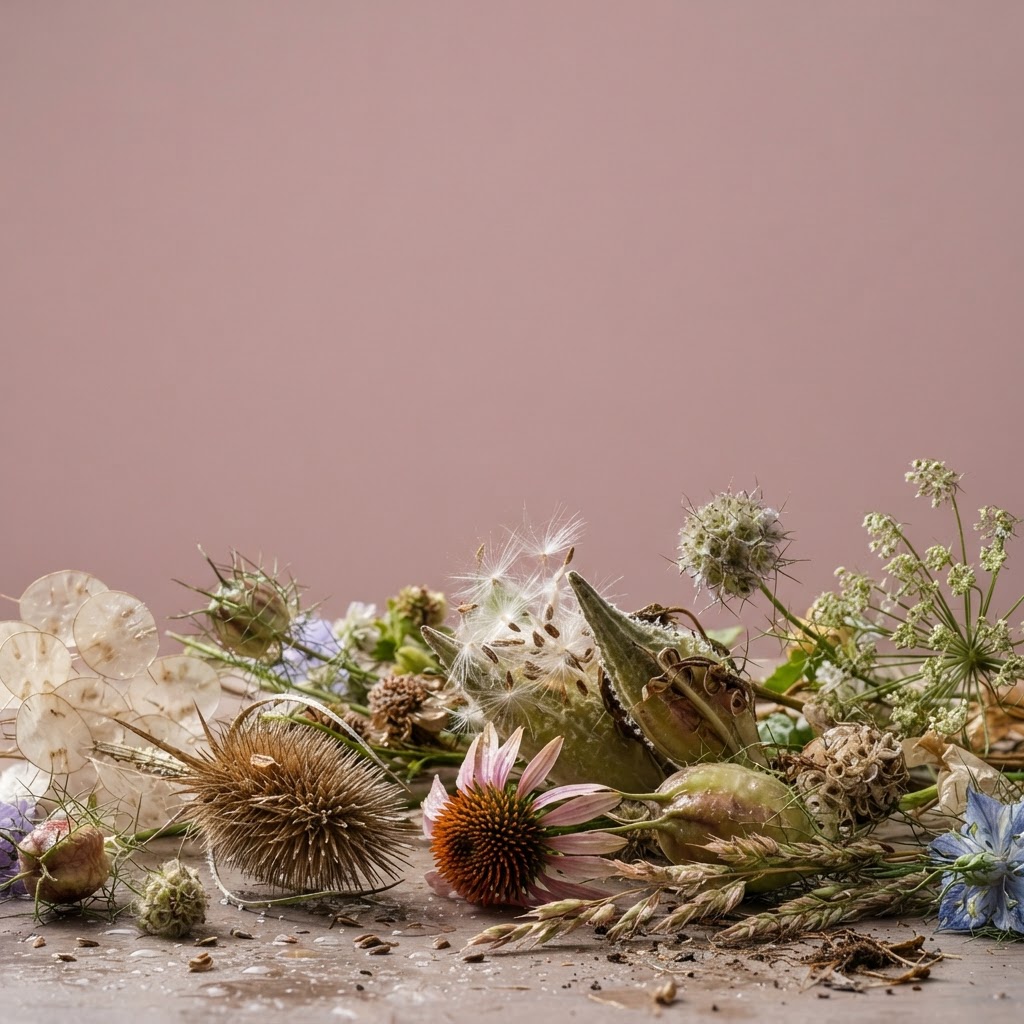
Start with the seed head, not the seed
If you still have the dried flower head, photograph that first. The structure of the fruit — whether it is a capsule that splits open, a pod that twists, a fluffy pappus, or a burr that clings — places the plant in a family immediately.
A poppy seed head is a hard, round capsule with pores under a little lid. An aster seed head is a mass of fluffy pappus. A lupin seed head is a pod that has dried and split with a twist. Those three look nothing alike and none of them requires you to see the seed.
Common wildflowers and their seeds
| Flower | Seed head type | Seed appearance | Giveaway |
|---|---|---|---|
| Poppy | Round capsule with pores | Tiny, kidney-shaped, pitted | Shakes out of the top like pepper |
| Cornflower | Cylindrical head of achenes | Elongated with a bristly tuft | A short brush of bristles at one end |
| Cosmos | Head of long achenes | Long, thin, dark with a beak | A slender, pointed beak on each seed |
| Lupin | A pod that splits and twists | Round, smooth, mottled | Seeds scatter audibly when the pod dries |
| Calendula | Ring of curved achenes | Crescent-shaped, spiny or smooth | The seeds curl into a C shape |
| Sunflower | Large head of achenes | Flat teardrop, striped | The classic black and white stripe |
| Nigella | Papery inflated capsule | Angular, wrinkled, black | The whole capsule looks like a tiny lantern |
| Marigold | Head of slender achenes | Long, thin, dark with a pale tip | Very uniform, needle-like seeds |
The appendages that identify a seed
- Pappus — the fluffy parachute on aster-family seeds such as cosmos and cornflower. Its length and colour separate species.
- Awns — stiff bristles that help the seed work its way into soil. Common in grasses and in some daisies.
- Wings — a thin papery margin around a flat seed, as in many trees and some wildflowers.
- Hooked bristles — the Velcro-like barbs on burrs that catch in fur and clothing.
- Elaiosomes — the small, pale, fleshy attachment on seeds such as violets and some wattles, which ants carry away.
Photographing tiny seeds properly
- Tip the seeds onto a plain white or black surface, whichever gives more contrast. Dark seeds on white, pale seeds on black.
- Put a coin or a ruler in the frame. Wildflower seeds are 1-4mm and the photo is meaningless without scale.
- Photograph from directly above with light from the side, so the surface texture and any appendage shows.
- If you still have the seed head, photograph it whole as well. The head identifies far more reliably than the loose seeds.
- Note the flower colour and shape if you remember it. That single detail often settles an identification that the seeds alone cannot.
A safety note on wild seeds
Several wildflowers have seeds that are toxic, and the seeds of the buttercup and delphinium families are among them. Lupin seeds are toxic unless processed, despite lupin being a food crop once treated.
Never taste a wild seed to help identify it, and wash your hands after handling seed heads you do not recognise. Identification from a photo is a guide, not a guarantee, and the cost of being wrong with seeds is higher than with a leaf.
Wildflower seeds are the hardest seeds to identify, because a great many of them are small, brown and roughly the same size. What rescues the identification is the seed head and the appendages on the seed itself — the fluff, the awn, the wing or the hooked bristle that the plant uses to move its seed away.
This guide covers the seed head types, the appendages worth photographing, and the common wildflowers you are most likely to be looking at.
Frequently Asked Questions
Because hundreds of species produce small, brown, similarly sized seeds. The seed head and the appendages on the seed — fluff, awns, wings or hooks — are what actually distinguish them.