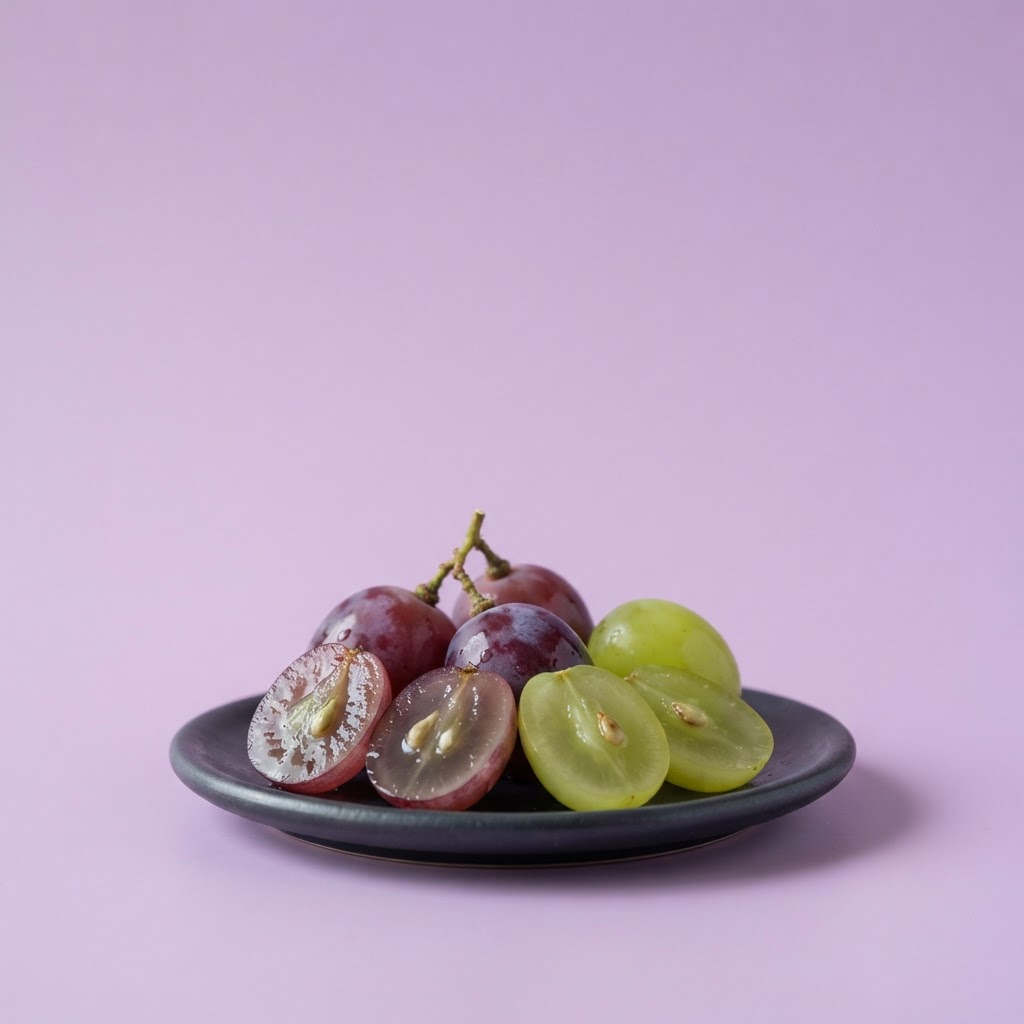
Is this grape seedless?
Pick the variety and find out whether it has seeds, and why the seedless ones still sometimes surprise you.
Seed status
Seedless — but not always seed-free
The original commercial seedless grape, selected in California in 1872. You will find no hard seeds, occasionally a tiny soft pip near the stem end.
A soft pale pip you can squash between your fingers is normal in a seedless grape. A hard, dark, fully-formed seed means a seeded variety slipped into the punnet.
Did we get this right?
One tap. It is how we catch the identifications that are wrong.
Every so often a grape gives you a small, pale, squashable pip and you spend a second wondering whether the punnet was mislabelled. It was not. That pip is the whole story of how seedless grapes exist.
Seedless grapes are not a species and not a genetic modification. They are ordinary grapes carrying a natural mutation that stops the seed from finishing.
The mechanism: stenospermocarpy
In a normal grape, a fertilised egg develops into a hard seed with a woody coat. In a seedless variety, the seed starts forming and then aborts a couple of weeks in. The flesh around it keeps growing — grapes are helped along by hormones from the developing seed, and growers replace those with a sprayed plant hormone, gibberellic acid, so the berry still sizes up.
That is why seedless grapes are usually a little smaller and a little more oval than seeded ones of the same variety, and why the soft trace you occasionally find sits close to the stem end. It is a seed that gave up.
Where the modern seedless grape came from
Almost every seedless table grape descends from Thompson Seedless, an 1872 selection by William Thompson in California — the grape Australians also know as the sultana. It was one lucky vine with the mutation, and a century and a half of breeding has been built on it.
| Variety | Seeds | What you notice |
|---|---|---|
| Thompson Seedless / Sultana | Seedless | Small, pale green, honey-sweet |
| Crimson Seedless | Seedless | Firm, snappy, holds up in lunchboxes |
| Flame Seedless | Seedless | Rounder, softer, occasional soft trace |
| Autumn Crisp | Seedless | Very crunchy late-season berry |
| Red Globe | Seeded | Big, coarse berries, one or two large seeds |
| Muscat Hamburg | Seeded | Aromatic, thin-skinned, bitter seeds |
Why seedless watermelons are a different trick
Seedless watermelons are not the same mechanism at all. They are grown from triploid seed — plants with three sets of chromosomes instead of two — which cannot form viable seeds. The white "seeds" you find in a seedless watermelon are undeveloped seed coats, soft and edible. Same consumer outcome, completely different biology.
Why seeded grapes are coming back
Flavour. The seedless trait has been bred in at the cost of aroma and acidity in many commercial varieties, which is why a Red Globe or a Muscat can taste dramatically more like grape than a perfectly crisp seedless berry. Growers in Spain, Italy and Australia have been quietly expanding seeded plantings for exactly that reason, and they sell at a premium to people who cook with them, juice them or remember what grapes used to taste like.
If you are buying for eating fresh and hate seeds, stay with Crimson and Autumn Crisp. If you are making juice, jelly or a grape focaccia, the seeded ones will give you more flavour for less money.
Practical notes
- A soft pale pip is normal in a seedless grape. A hard dark seed means a mixed punnet.
- Check the stem, not the berry. Green flexible stems mean a fresh bunch; brown and brittle stems mean it has been in the cool room a while.
- The white bloom is not pesticide. It is the grape's own protective wax, and it is a sign the bunch has not been handled much.
Frequently Asked Questions
No. Seedless varieties come from a natural mutation that stops the seed from developing, then conventional breeding and grafting. Growers also apply gibberellic acid, a plant hormone already present in grapes, to help the berries size up.