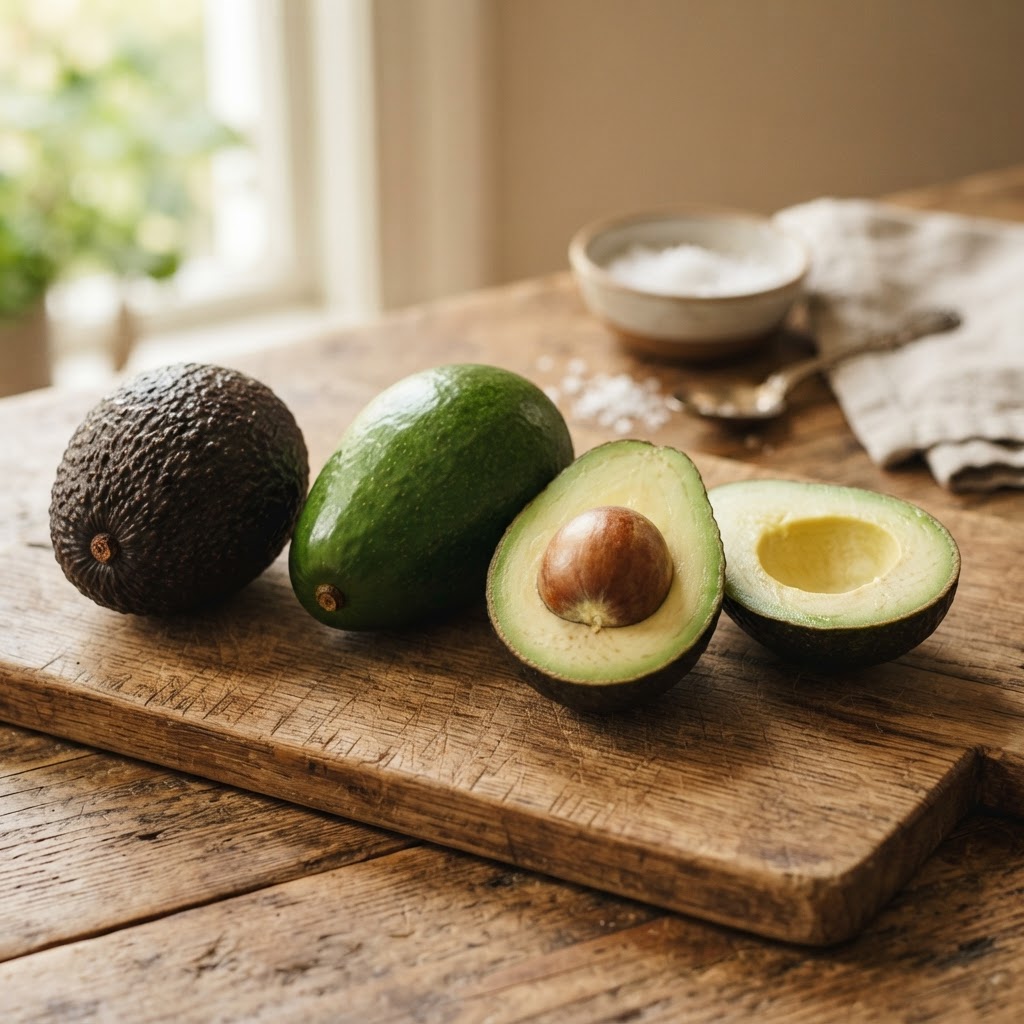
Avocados are grown commercially across every mainland state in Australia, and the varieties shift through the year in a way that catches people out. The one everyone knows — Hass — is not even available in top quality for part of the year, which is exactly when Shepard takes over.
Identification comes down to skin texture, skin colour, shape and season. There is one catch that trips up almost everyone, and it is worth leading with.
The Green-Skin Trap
Hass avocados darken as they ripen. They go from green to deep black-purple, and that colour change is a reasonably reliable ripeness signal. Most people learn to judge avocados this way and then apply the same rule to every variety.
That fails with Shepard, and it fails badly. Shepard stays green when ripe. So do Fuerte, Reed, Wurtz and Bacon. A Shepard can sit on your bench turning black and rotten inside while the skin stays a healthy green, because colour is simply not part of how that variety signals ripeness.
For green-skin varieties you have to use the squeeze test or the stem nub. Cup the avocado in your palm and press gently — a ripe one gives slightly under firm pressure, like a ripe peach. Or flick the small stem cap at the top: if it comes away easily and reveals green flesh underneath, the fruit is ready. If it resists, it is not. Our general guide to picking ripe fruit covers the same principles across other fruit.
The Varieties
- Hass — the dominant variety worldwide and in Australia. Oval, 200 to 300g, with distinctly pebbly, leathery skin that turns black-purple when ripe. High oil content around 20%, which gives it the rich, nutty flavour people associate with avocado. Available year-round but at its best from May to January.
- Shepard — smooth, glossy green skin that never darkens. Smaller and milder than Hass with lower oil content and a lighter, slightly sweeter flavour. Available February to April, which is precisely when Hass quality drops.
- Reed — large and almost spherical, weighing 300 to 500g, with smooth green skin. Buttery and mild with a small seed relative to the fruit. A summer variety.
- Fuerte — pear-shaped with smooth green skin and a medium oil content. Once the dominant commercial variety before Hass displaced it. Mild and slightly grassy.
- Wurtz — a dwarf variety that fruits well in containers and small gardens. Small, pear-shaped and green-skinned with good flavour.
- Pinkerton — long and slender with green skin that stays green, and a notably small seed. Creamy with a mild flavour.
Comparing Them
| Variety | Skin | Shape | Ripe colour | Season |
|---|---|---|---|---|
| Hass | Pebbly, thick | Oval | Black-purple | May–Jan |
| Shepard | Smooth, glossy | Oval, smaller | Stays green | Feb–Apr |
| Reed | Smooth | Large, round | Stays green | Summer |
| Fuerte | Smooth, thin | Pear-shaped | Stays green | Autumn–winter |
| Pinkerton | Smooth, thin | Long, slender | Stays green | Winter |
| Wurtz | Smooth | Small, pear | Stays green | Varies |
Skin texture is the fastest separator. If the skin feels like fine sandpaper, it is almost certainly Hass. If it feels smooth and slightly waxy, it is one of the green-skin varieties, and then shape narrows it down — pear-shaped means Fuerte or Wurtz, large and round means Reed, long and slender means Pinkerton.
Identifying an Avocado Tree
Avocado (Persea americana) is an evergreen tree that can reach 15 metres in the tropics but usually stays smaller in a garden. The leaves are the easiest feature: oval to lance-shaped, 10 to 25cm long, dark glossy green above and noticeably paler underneath, with a prominent midrib and fine hairs along the veins on the underside.
New growth flushes in waves and comes out reddish-bronze before hardening to green, which gives an avocado tree a distinctly two-toned appearance through the growing season. The bark is grey-brown and shallowly fissured, and the trunk is often slightly flared at the base.
The flowers are small, greenish-yellow and borne in dense clusters. They are also genuinely strange. Avocado flowers open twice — once as a female, then again as a male — and the timing differs between varieties. Hass, Fuerte, Pinkerton and Reed are A-type, opening female in the morning. Shepard, Bacon, Edranol and Wurtz are B-type, opening female in the afternoon. Because the male and female phases of a single tree rarely overlap, planting one A-type and one B-type nearby dramatically improves fruit set. A lone avocado tree often flowers heavily and sets almost nothing.
The Ripening Oddity
Avocados do not ripen on the tree. A fruit left on the branch will keep accumulating oil and will eventually go over, but it will never soften into something you want to eat. They are climacteric fruit, and ripening is driven by ethylene after picking.
That is why hard avocados in a shop are not a fault — they are simply unripe, and they will soften on your bench in three to seven days. Speeding that up is easy: put them in a paper bag with a ripe banana or apple and the ethylene concentration rises fast.
What you should not do is refrigerate an unripe avocado. Cold stops the ripening process and it does not restart properly afterwards, which is why some avocados seem to sit at rock-hard forever and then rot in a day. Our guide to why some avocados never ripen explains the cold-storage problem in detail, and when to refrigerate avocado covers the timing.
Once cut, avocado browns quickly. That is enzymatic oxidation rather than spoilage, and the flesh is still safe to eat — but lemon juice and airtight wrapping slow it down considerably.
What You Get Nutritionally
Avocado is unusual among fruit for its fat content, which is predominantly monounsaturated and is the reason it feels rich rather than sweet. Hass, with its higher oil content, carries more fat per gram than Shepard or Fuerte. That is also why Hass has the flavour advantage.
A serve is smaller than most people assume — about a third of a medium avocado. Our guide to how much avocado is a serving breaks down the numbers. And despite the fat content, eating avocado in normal amounts is not associated with weight gain, which our piece on whether avocado will make you fat covers.
Botanically, the avocado is a single-seeded berry rather than a vegetable, which is why it counts toward your fruit intake. Our explanation of whether avocado is a fruit or a vegetable covers the classification.
The Short Version
Pebbly skin means Hass, and it will turn black-purple when ripe. Smooth green skin means Shepard, Fuerte, Reed, Wurtz or Pinkerton — and none of those change colour, so use the squeeze test or the stem nub instead. Pear-shaped means Fuerte or Wurtz, large and round means Reed, long and slender means Pinkerton. And remember that no avocado ripens on the tree; ripening only starts after picking.
Frequently Asked Questions
Start with skin texture. Pebbly skin means Hass, which turns black-purple when ripe. Smooth green skin means Shepard, Fuerte, Reed, Wurtz or Pinkerton. Then use shape — pear-shaped is Fuerte or Wurtz, large and round is Reed, long and slender is Pinkerton.